Remote operator placement providers with a real replacement guarantee
What a replacement guarantee actually covers, how the most-compared providers stack up, and why the guarantee is the least important reason to trust any of them.

You did not end up here because you like reading fine print. You ended up here because the last remote hire did not work out, or because you are not willing to find that out the expensive way twice.
Every provider in this category will tell you they stand behind their placements. This is what that actually means at each one, in plain terms, without the sales page version. If you have already been burned once, start with the part nobody puts on the pricing page: what a guarantee covers, and what it quietly does not.
What does a replacement guarantee actually promise?
A replacement guarantee is a provider's written commitment to re-run its matching process and send you someone new, at no extra cost, if the first placement genuinely does not work. That is different from being able to cancel. Canceling ends the relationship and leaves you starting over on your own. A guarantee means the provider absorbs the cost of getting it wrong, not you.
It exists because a bad hire is expensive everywhere, not only in-house. What did the last one actually cost you? Most founders count the salary and stop there. One widely cited estimate, from the U.S. Department of Labor, puts the real number at 30 percent or more of the role's first-year earnings once the redo, the lost time, and the disruption are counted, and that math does not change because the hire was remote.
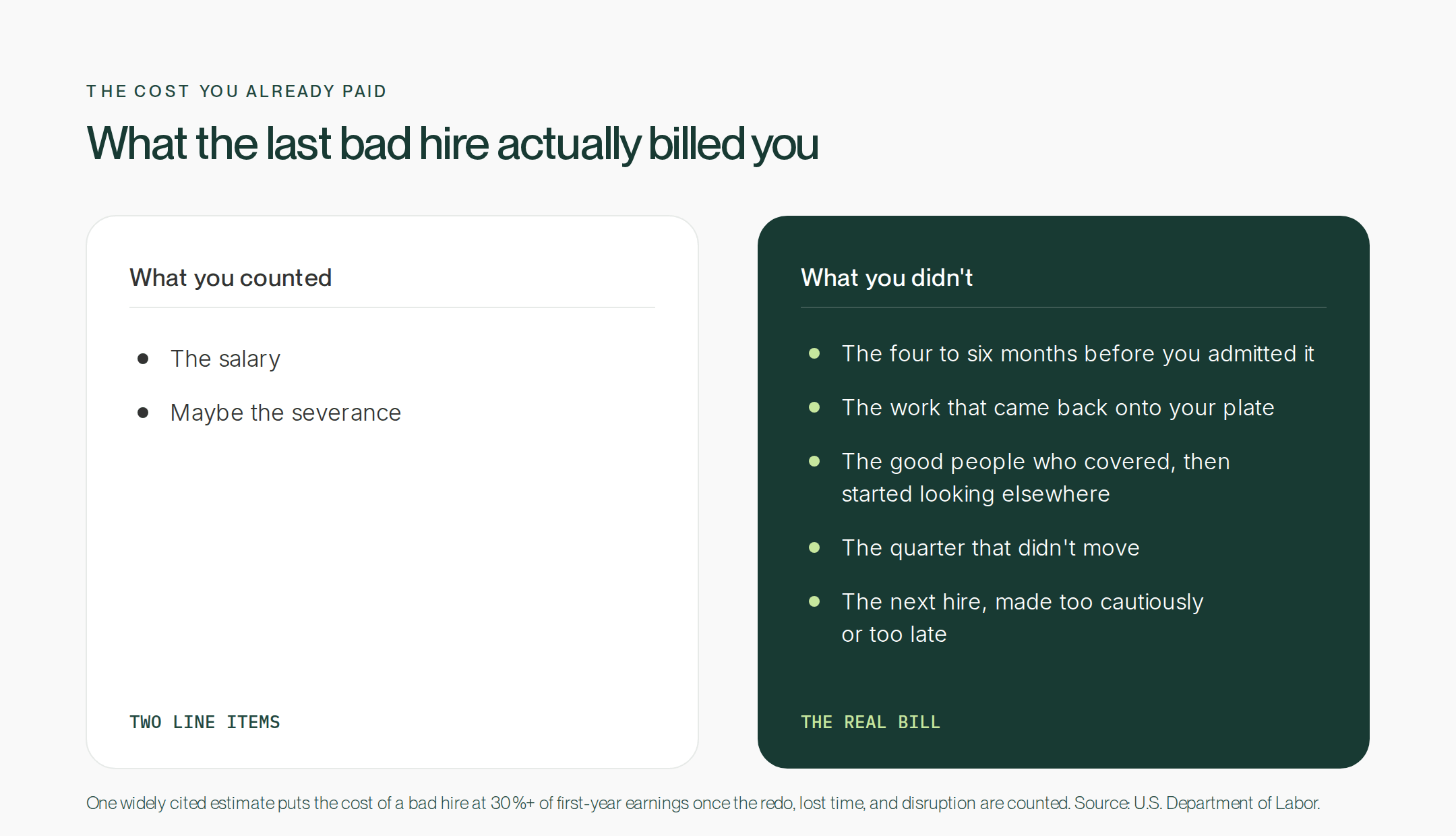
Your own version of that right-hand column is the only bad-hire figure worth quoting at you. It is also the number that should set how much evidence you demand from here on.
Guarantee versus trial period: the difference that actually matters
A trial period protects your ability to leave. A replacement guarantee protects your ability to keep the work moving. If a compliance deadline, a client renewal, or a multi-location rollout cannot absorb a multi-week coverage gap, the difference is not academic. One gets you out. The other gets you a working operator without restarting the search from zero.
Seven signs a replacement guarantee is real, not marketing copy
Almost every provider in this category uses the word guarantee somewhere on the site. Here is what separates a real one from a sentence written to reassure you into signing.
- A specific, written time window in the contract, not a verbal "if it's not working out, just let us know."
- No re-vetting fee. The replacement should cost nothing beyond what you already pay monthly.
- A defined re-match process, not a faster resend of whoever else was already on the shortlist.
- Continuity of onboarding. Your SOPs, tool access, and context transfer to the new person instead of starting cold.
- A named point of contact who owns the transition. Not a support ticket queue.
- Terms that survive a reasonable scope change. A small shift in month one should not quietly void coverage.
- Findable language. If you cannot read the terms without talking to a salesperson first, that is itself the signal.
Why the matching process matters more than the guarantee itself
A guarantee only gets used when the first match has already failed. The better goal, for any provider you choose, is a process good enough that you rarely need it. That is the whole idea behind Proof over Promise. Every provider in this category will tell you they have great people. The honest question is not whether they say it. It is whether you can see it before you commit to anyone.
See the work before you decide on the person.
Laith Masarweh
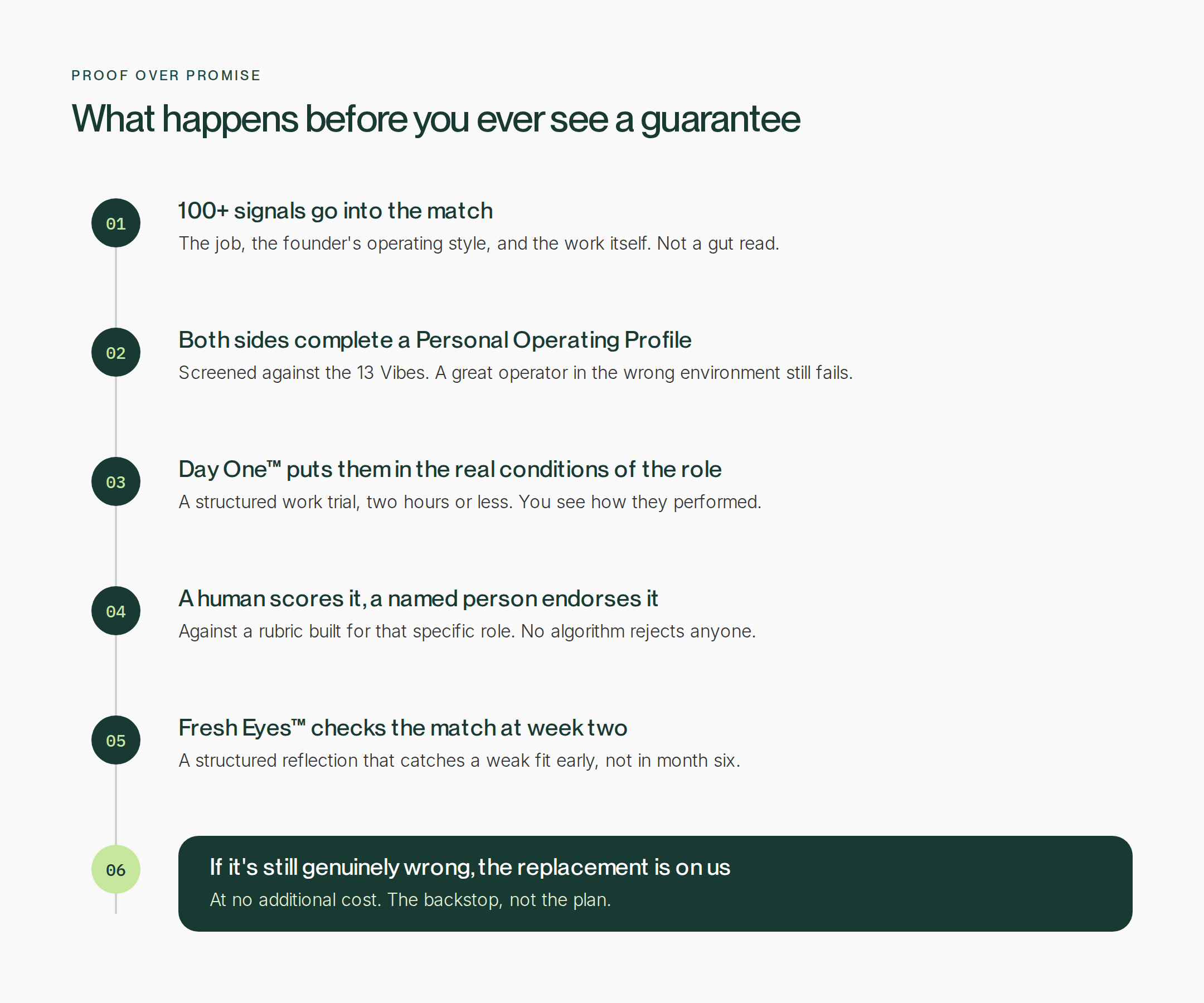
Here is our mechanism, in the order the evidence arrives.
- 100+ signals go into the match, spanning the job itself, the founder's operating style, and the candidate's actual work, not a resume and a gut read.
- Both sides complete a Personal Operating Profile, and every candidate is screened against a named trait set, the 13 Vibes, so the person is matched to how you actually run your company at this stage rather than to a generic skill list. A great operator in the wrong operating environment still fails.
- Day One™ puts the candidate in the real conditions of the role. A structured work trial, two hours or less. You see how they performed. You do not keep, use, or ship the work itself.
- A human reviews it against a rubric built for that specific role, and a named person on our team writes the endorsement that reaches you. No algorithm rejects anyone.
- Fresh Eyes™ runs at week two. A structured reflection after placement where the operator tells us what is working, what is not, and what they would change. It catches a weak match early instead of in month six.
- If a match is still genuinely wrong, we replace the operator at no additional cost. The process is built to get it right the first time. Sometimes we still get it wrong, and when we do, that is ours to fix rather than yours to absorb.
The 13 Vibes: Creative, Collaborative, Proactive, Curious Learner, Strong Communicator, Gets Sh*t Done!, Responsible + Respectful, Adaptable, Responsive, Critical Thinker, Consistent, Problem Solver, Organized.
What to hand off, and what stays founder-owned
A guarantee should never be the reason you hand over something you should not have delegated in the first place. This split holds whichever provider you use.
| Delegate to your operator | Keep founder-owned |
|---|---|
| Calendar, inbox, and scheduling triage | Final hire and fire decisions |
| CRM cleanup and pipeline updates | Pricing and contract terms |
| Client-facing follow-ups and status updates | Relationship judgment calls |
| First-draft research and reporting | Anything needing legal or financial sign-off |
| Recurring compliance checklists and reminders | Exceptions to your own SOPs |
A closer look at each option
SupaHumans
Talent intelligence and team architecture, not a marketplace or an administrative staffing line. Before you ever meet an operator, the role has come out of the Team Architecture Diagnostic™, which maps how the business runs today and shows exactly where it still routes through you.
Where it holds up. The guarantee sits behind a process rather than instead of one. Fresh Eyes™ catches a weak match at week two, not month six. Placement reaches past admin support into operations, client success, finance, and director-level seats.
Where it does not. There is more upfront process before you meet anyone, so if you want a shortlist today with no work trial, this will feel slow. Timeline is scoped per role rather than promised flat: well-defined roles move quickly, senior and multi-hat roles take longer. Pricing is not a published menu either, it is scoped at the diagnostic.
Best for: founders who would rather pay for a lower chance of ever needing the guarantee than for the fastest possible turnaround.
Wing Assistant
A flat-rate, plan-based model built around predictable monthly cost. Published plans include a stated replacement policy, which puts Wing ahead of most budget-tier options on transparency.
Best for: founders who want lighter, well-defined administrative coverage at a published price, and who are comfortable running more of the onboarding themselves.
Prialto
The model leans on a backup assistant and an engagement manager built into every account, so continuity comes from the team structure rather than from a formal, publicly documented replacement guarantee.
Best for: founders who prioritize built-in coverage during absences over the lowest entry price.
Magic
An hourly, on-demand model. Cost scales with usage rather than sitting at a flat plan, which suits variable workloads but makes a full-time equivalent considerably more expensive than the flat-rate options here.
Best for: founders with genuinely unpredictable, spiky workloads who do not want a fixed monthly commitment.
Belay
Positions on US-based talent and a custom-quoted, white-glove matching process. Pricing is not published, and neither are guarantee terms in detail, so both require a direct conversation before you can compare them against anything else here.
Best for: founders who specifically require US-based, domestic-timezone talent and are comfortable paying a premium for it.
Upwork, or hiring it yourself
Upwork is a marketplace, not a placement provider, so no vendor is obligated to re-match you if a hire does not work out. Entry cost is the lowest of anything on this list and you keep full control of who you interview. The vetting, the trial design, and the ongoing oversight are all yours, and a bad fit means re-running the entire search yourself.
Best for: one-off or narrowly scoped project work, or founders with the bandwidth to vet and manage a hire themselves.
What a guarantee looks like in practice
These are composite scenarios built from how the mechanism above is meant to work, not a specific client's story.
- A logistics operator and an unfamiliar dispatch system. The fit feels off in week one. Fresh Eyes™ surfaces it at the two-week check-in, and a re-matched operator with the right systems background steps in without a restart fee.
- A multi-location insurance agency and a pace mismatch. The operator is technically strong, but the way they handle ambiguous requests does not fit how the founder runs meetings. The re-match sorts on working style, not skill, and the swap holds.
- A founder second-guessing a rough first week. Before triggering a replacement, a named point of contact walks through the actual work log with the founder. The fit turns out to be fine, and an unnecessary swap gets avoided.
How to vet any provider's replacement guarantee before you sign
- Ask for the guarantee in writing. Not a verbal assurance on a sales call.
- Ask what replacement actually includes. Full re-vetting, or a faster resend of the leftover candidates?
- Ask what voids it. A minor scope change or some SOP drift should not quietly cancel your coverage.
- Ask who owns the transition. Get a name, not a support-ticket process.
- Check the window against your actual ramp time. A short guarantee is thin if the role genuinely takes six weeks to onboard.
Run those alongside the red flags that predict a bad remote hire and you will catch most of what a contract review on its own misses.
How we built this guide
This comparison combines our own published process with publicly available pricing and policy information for Wing Assistant, Prialto, Magic, Belay, and Upwork, gathered from provider pricing pages and independent reporting as of September 2026, cross-checked against U.S. Department of Labor bad-hire cost data. Pricing and terms change without notice across this entire category, ours included. Confirm current numbers directly with any provider before you sign anything.
The bottom line
A guarantee is a backstop, not a plan. The providers worth comparing are the ones that can show you why you will rarely need it, not the ones most willing to promise it.
If you are not sure which seat you are even hiring for, that is the decision underneath the search, and it is what the Team Architecture Diagnostic™ is for. Twenty minutes on how the business runs today, and you leave with the map: the org you should have, the sequence, and which seat comes off your plate first. If it turns out you already know the seat cold, we will tell you so and skip straight to the work.
Proof over Promise.
The Assistantly x SupaHumans Team ⚡️
Common questions
This is how we hire, and it's the standard we hold our own team to. The long version lives in our manifesto. If you're hiring, start here. If you're talent, start here.