Critical thinking is becoming the core skill of workforce readiness
SHRM's 2026 benchmarking data puts critical thinking among the fastest-rising workforce priorities. What it looks like on the job, and how to hire for it.

If your next hire has to reason through a problem rather than execute a checklist, that is a hiring question before it is a training question.
SHRM's 2026 L&D Executives Benchmarking data, drawn from more than 1,800 L&D professionals and thousands of surveyed workers, shows critical thinking and judgment climbing faster than almost any other skill category organizations plan to prioritize over the next five years. Below: what that shift looks like on the job, six signs your team is running short on judgment rather than training, and how to hire for it deliberately instead of hoping it shows up.
What is critical thinking as a workforce readiness skill?
Critical thinking as a workforce readiness skill is the ability to evaluate evidence, question assumptions, and reach a defensible conclusion, especially when the answer is not handed to you by a dashboard or a model. SHRM's Executive Network reports that its 2026 benchmarking data shows critical thinking and judgment climbing faster than almost any other skill category organizations plan to prioritize over the next five years. That is not a soft-skills footnote. It is a market signal that credentials and task completion no longer tell an employer what they need to know about how someone actually reasons.
What is the difference between being trained and being ready?
Being trained means someone can follow a known procedure. Being ready means they can work out what to do when the procedure does not cover the situation in front of them. As AI absorbs more of the procedural work, the gap between the two is what is left for people to fill, and it is exactly the gap SHRM's data shows employers scrambling to close.
Most learning and development strategies were built to close skills gaps that could be named and taught directly: a software tool, a compliance requirement, a technical certification. Critical thinking does not fit that mold, which is part of why it has only now become a priority instead of an assumption. Organizations built training pipelines for the easy half of readiness and are only now confronting the harder half.
Six signs your team needs critical thinking, not more training
- New hires ask what to click, not why it matters. Onboarding is producing task-followers, not problem-solvers.
- Escalations spike the moment a situation is even slightly non-standard. No one is comfortable reasoning outside the documented case.
- Feedback gets accepted without pushback, even when it is wrong. People are absorbing input instead of evaluating it.
- Post-mortems keep citing "we followed the process," as if following the process were the same as it being the right one.
- Your best performers are the only ones who ask good questions. Judgment is not distributed across the team. It is concentrated in one or two people.
- Training completion rates are high, but judgment on the job has not visibly improved. You are teaching content, not building the reasoning to apply it.
Read those six together and they describe a business where every non-standard call still routes back through one person, usually you.
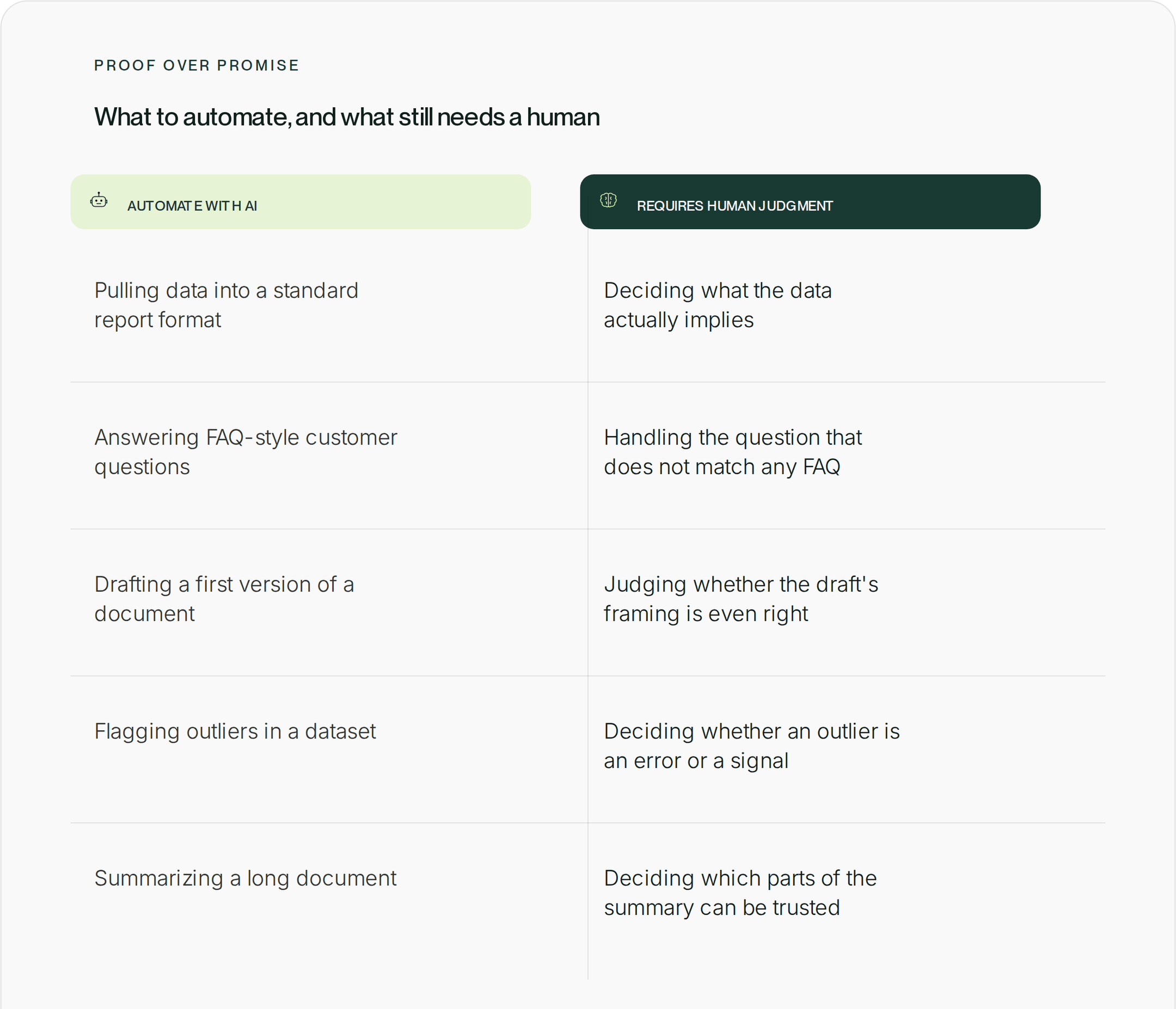
What to automate, and what still requires critical thinking
Some of this splits cleanly. The version below is worth pinning above a desk.
Why does critical thinking matter more than task speed?
Task speed is easy to measure and easy to automate, which is exactly why it stopped being the differentiator. SHRM's benchmarking data shows critical thinking and judgment rising precisely because the tasks that used to prove competence, following a process quickly and accurately, are the tasks AI now does at scale. What is left to hire and train for is the reasoning that decides which process applies, when to deviate from it, and how to handle the exception no procedure covers.
That shift changes what readiness should mean in a job description. A candidate who can execute a documented workflow flawlessly is necessary but no longer sufficient. The workforce-readiness gap SHRM is measuring sits in the reasoning layer above the workflow, not in the workflow itself, which is the same reason AI fluency beats AI awareness on a resume.
A resume shows what someone has done. An interview shows how someone talks about what they have done. Neither one puts a candidate in front of an ambiguous, real-condition problem and watches how they reason through it.
How do you hire for critical thinking instead of credentials?
Most hiring processes were not built to test this, which is why judgment keeps slipping through a resume screen and a confident interview. The bad hire you already made probably cleared both. What did not show up until month three or four was how they handled the situation that was not in the job description, and by the time it surfaced, the work was already back on your desk.
Here is how we test for it before a candidate ever reaches you. Matching starts with a Personal Operating Profile, a hundred-plus data signals spanning the role, your operating style and the work itself, not a gut read on a resume. Every operator is also screened against the 13 Vibes, our named trait set, which includes Critical Thinker and Problem Solver by name. From there the candidate completes Day One™, a structured work trial in the real conditions of the role, two hours or less. A human reviewer scores it against a rubric built for that specific role, and a named person on our team writes the endorsement that reaches you. No algorithm rejects anyone, and no AI interviewer stands between a candidate and a human decision. You meet the Unicorn, our term for an operator who has cleared this standard, only after they have already proven the reasoning.
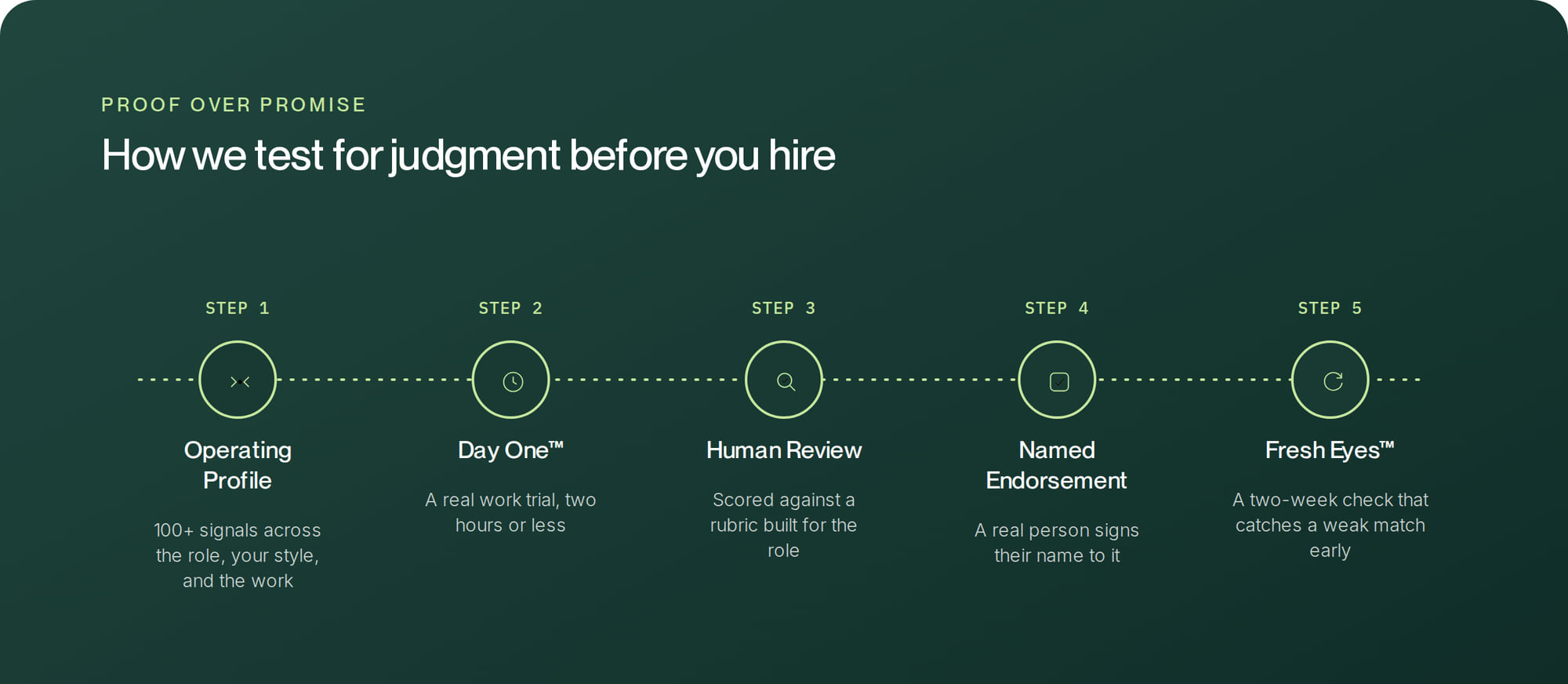
That is the mechanism. The small ask on your side is the Team Architecture Diagnostic™: twenty minutes to map which seat in your business needs this kind of judgment first, before either of us talks about a placement.
Can you hire for critical thinking with a marketplace or job board?
Where it works: lower cost for well-defined, low-ambiguity tasks, and it is fast to post and get applicants.
Where it breaks down: there is no structured way to assess reasoning before hiring, so you are guessing from a resume and a conversation. There is no onboarding built around developing independent judgment, and quality varies widely from one contractor to the next. Run the red flags that predict a bad remote hire against your last marketplace shortlist and most of them are untestable there.
Best for: a task with a single correct answer and minimal ambiguity, not a role that depends on judgment calls.
How does this testing actually work for a specific role?
Day One™ mirrors a real, ambiguous situation inside the role itself: drafting a client escalation reply with incomplete information, triaging a stack of vendor invoices with one that does not match the purchase order, reconciling a schedule when two locations report conflicting numbers. Reasoning through incomplete information under real conditions is the assessment, not a personality quiz. The Personal Operating Profile then aligns that reasoning style with how you personally communicate and delegate, so a good reasoner and a bad fit for your company do not get confused for each other.
What are real examples of critical thinking on the job?
Customer support. A ticket does not match any documented issue. Instead of escalating blindly, the rep reasons through what is actually happening and resolves it.
Data reporting. A monthly number looks off. Rather than reporting it as is, someone traces it back and finds a broken data feed before it reaches leadership.
Vendor and compliance. A contract renewal or a licensing requirement includes a clause that reads standard but is not, given the company's specific volume or jurisdiction. Someone catches it before signing.
Multi-location operations. Two locations report the same metric two different ways. Someone notices the definitions do not match before either number gets used to make a decision.
Hiring support. A candidate's resume is thin but their live work sample is strong. The reviewer weighs the actual signal over the credential.
How do you build critical thinking into your hiring and onboarding?
- Test reasoning during hiring, not after. A live, ambiguous scenario reveals more than a resume ever will.
- Require new hires to explain why, not just what, during their first ninety days.
- Build intentionally ambiguous onboarding tasks that do not have one documented right answer.
- Reward people for catching and flagging problems, not just for completing assigned work.
- Track judgment quality over time, not just task volume, in performance reviews.
How we built this guide
This guide draws on SHRM's 2026 L&D Executives Benchmarking data, surveying more than 1,800 L&D professionals and thousands of workers, as reported by the SHRM Executive Network, alongside the hiring mechanism we use in our own placements. SHRM's data is theirs. The process details are ours, verified against how we actually run a match. Pricing is not part of this piece; it is scoped per business at the Team Architecture Diagnostic™ stage, not published as a flat rate.
See the work before you decide on the person.
The bottom line
Critical thinking is rising to the top of workforce-readiness priorities because it is the one thing AI has not absorbed: the ability to reason through what a model, a process, or a resume cannot tell you. Hiring for it deliberately, testing it with a real work trial instead of a credential, and building it into onboarding are what separate teams that adapt from teams that just execute faster.
The Team Architecture Diagnostic™ maps how your business runs today and hands back the org you should have, starting with the seat that comes off your plate first. Twenty minutes, no contract. If it turns out you already know the seat cold, we will tell you so and skip straight to the work.
Proof over Promise.
The Assistantly x SupaHumans Team ⚡️
Common questions
This is how we hire, and it's the standard we hold our own team to. The long version lives in our manifesto. If you're hiring, start here. If you're talent, start here.