How to hire an operator with real AI judgment, not just AI tools
What AI judgment actually looks like in the work, how a scored trial proves it before you hire, and why a tool list is not fluency.

You did not build this to become the thing it cannot run without.
Right now you are still the last set of eyes on every AI-drafted email, every investor update, every research brief before it leaves the building. Not because you do not trust delegation. Because the one time you did, the draft came back fluent, confident and wrong, and nobody caught it until you did.
AI-trained is not a tool list. It is a track record of catching what AI gets wrong before a client, an investor or a regulator ever sees it. You cannot interview for that. You can only watch someone do it, under real conditions, and have a human score it against a rubric built for the role. That is the whole argument below.
What does "AI-trained" actually mean?
An AI-trained operator uses AI tools inside real, daily work: drafting, research, data cleanup, scheduling logic. Then they verify what the tool produced, protect anything confidential, and apply judgment before it ships. The tool is the first pass. The judgment is the job.
Adoption backs that up more than it should reassure anyone. A compiled analysis from Gloat puts knowledge-worker AI use at 75% (McKinsey) against 9% of organizations reaching genuine AI maturity (Gartner). The distance between those two numbers is not a tooling problem. It is a people problem, and it is exactly where a founder gets burned.
What is the difference between using AI and having AI judgment?
Using AI means pasting a prompt into a chat window when it occurs to you. AI judgment means treating AI as a default step in a workflow and then catching what it got wrong before anyone else sees it.
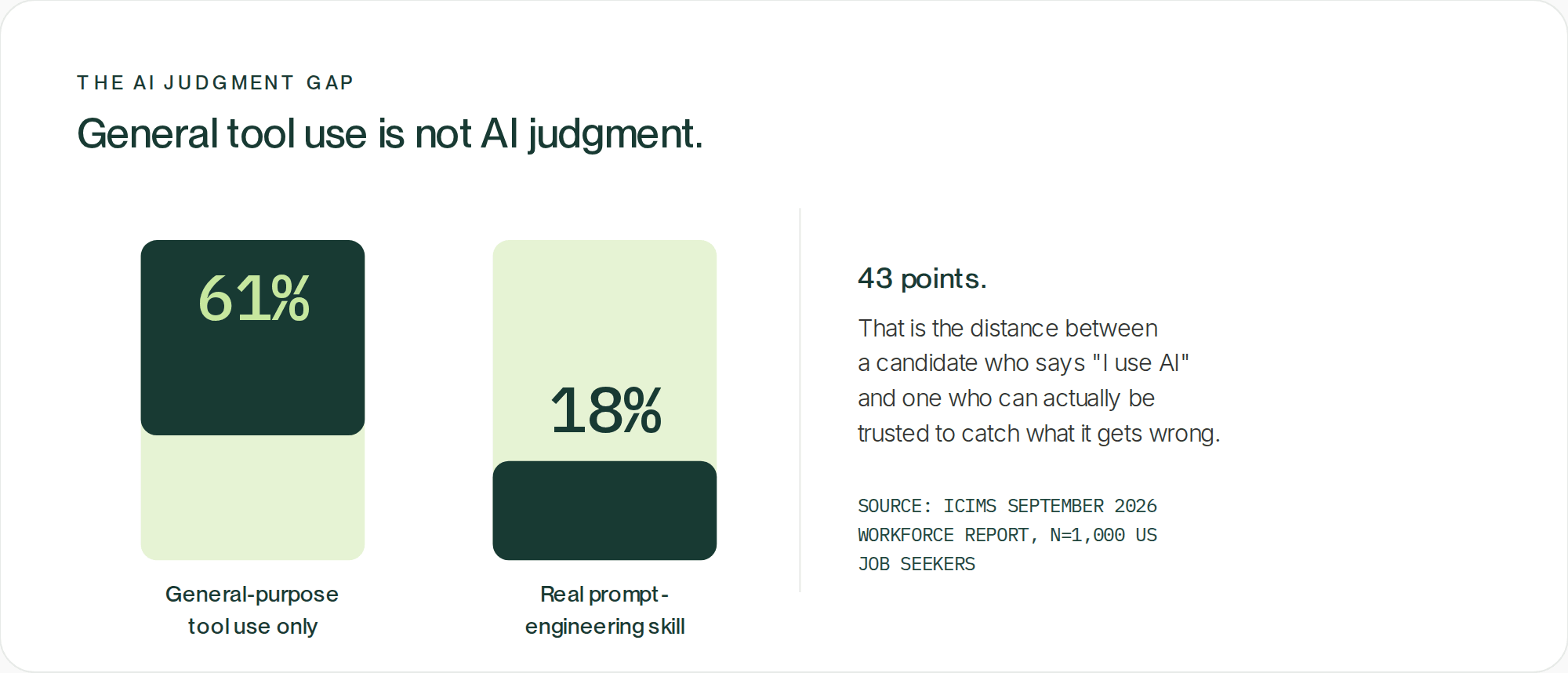
ICIMS' September 2026 Workforce Report surveyed 1,000 U.S. job seekers and found 61% describe their own AI proficiency as limited to general-purpose tools like ChatGPT or Copilot, while only 18% report anything like real prompt-engineering skill. That 43-point gap is the exact distance between "uses AI" and "AI-trained." Most candidates who call themselves AI-fluent on a resume are describing the smaller number without knowing it, which is the same reason we screen for AI fluency rather than AI awareness: the tools are easy to list and hard to use well.
The seven signals of real AI judgment
- Workflow-first tool use. They reach for AI inside a task, not as a separate side project.
- Visible verification habits. They flag what they did not check and never present an AI draft as finished work.
- Prompt literacy beyond the default. They iterate a prompt until it is usable instead of accepting the first pass.
- Range across the tool stack. Comfortable moving between a writing tool, a scheduling tool and a research tool, not married to one favorite app.
- Judgment on ambiguous calls. They know when a task needs AI speed and when it needs a human's full attention.
- Documentation instinct. Repeat tasks become a written process, so quality does not live only in one person's memory.
- Comfort being tested. No flinching at a live task or a scored work sample.
What did your last AI-confident hire actually cost you?
You probably counted the salary. Maybe the severance.
What you likely did not count: the afternoon you spent re-checking everything else that person had touched that month, because you no longer trusted the first version of anything they sent you. The client email that went out with a number nobody verified. The research brief you presented as your own and only later found had a fabricated source in it. The weeks it took before you admitted the problem was not the tool, it was that nobody ever checked whether this person could tell the difference between a good AI draft and a dangerous one.
That is the number worth sitting with before your next hire, not a statistic we could hand you. It is the cost of a hire you could not verify, and it never appears on the offer letter.
Is this just a virtual assistant with AI skills?
No, and the distinction is the whole point. A virtual assistant model sends you a stack of resumes and leaves the interviewing, the trial and the guessing to you. We are talent intelligence and team architecture: we map where the load actually sits in your business, then match and prove an operator against that map before you ever meet them. The AI skill is one input into that match. It is never the whole pitch.
How do you actually prove someone has AI judgment before you hire them?
You do not ask. You watch, under real conditions, and you let a human score it.
Day One™ is a structured work trial in the real conditions of the role, two hours or less, scored by a human against a rubric built specifically for that seat. You see how the candidate actually performed, including where AI entered their process and where they overrode it. We do not keep, use, or ship the work itself.
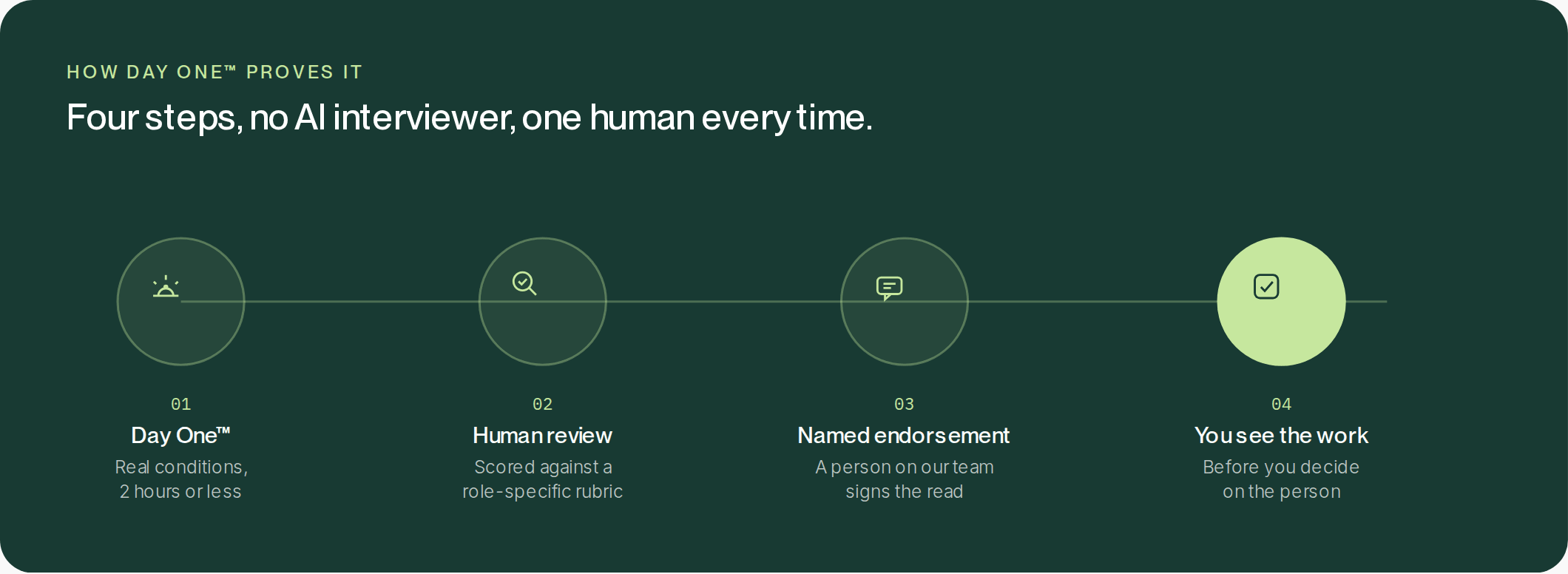
No algorithm rejects anyone, and no confident, well-formatted transcript stands in for a human's read on the work. That matters more as the tools get better at sounding right, which is the same trap AI sets for leadership judgment.
See the work before you decide on the person.
Skill is only half of it. Both sides complete a Personal Operating Profile, and we match how the person actually works against how you actually run this business at this stage. An operator who is AI-fluent but built for a fast, ambiguous startup will still fail inside a business that runs on documented process, and the reverse is just as true. That match runs on more than a hundred signals pulled from the role, your operating style and the work itself, not a gut read on a resume.
Every operator is also screened against the 13 Vibes: Creative, Collaborative, Proactive, Curious Learner, Strong Communicator, Gets Sh*t Done!, Responsible + Respectful, Adaptable, Responsive, Critical Thinker, Consistent, Problem Solver, Organized. AI judgment leans hardest on Critical Thinker and Responsible + Respectful, and a seat that also needs Proactive or Collaborative gets screened for that too.
Real examples of AI judgment on the job
Investor updates. AI drafts the monthly numbers summary from raw data. The operator catches a metric that does not match the source sheet and holds it until it is confirmed.
Inbox triage. AI flags and drafts replies to routine requests. The operator escalates anything from a legal, press or upset-client sender instead of letting it auto-send.
Research briefs. AI pulls a first-pass competitive scan. The operator verifies each claim against a primary source before it goes into your deck.
Process documentation. AI turns a recorded walkthrough into a draft process doc. The operator edits it against how the task is actually done, not how AI assumed it works.
How can you screen for AI judgment yourself?
If you are hiring without us, these five questions do the most work.
- Ask for a specific task they sped up with AI, and what they changed before sending it.
- Give a short, real task, not a generic prompt test, and watch which tool they reach for and why.
- Ask what they would refuse to run through AI. The answer reveals more judgment than any demo.
- Check how they document a process, not just how they complete one.
- Confirm what happens after they are hired. Coaching, or does their skill freeze at day one?
Run those alongside the red flags that predict a bad remote hire and you will catch most of what an interview misses on its own.
How we built this guide
This guide draws on ICIMS' September 2026 Workforce Report, which surveyed 1,000 U.S. job seekers on AI proficiency, and a compiled analysis from Gloat citing McKinsey and Gartner data on AI adoption and organizational maturity. Where this piece describes our own process, that is us describing our own process, not research.
The bottom line
The plan got cheap. Installing it did not.
Every founder can now describe what AI-fluent hiring should look like. Almost none of them can prove a candidate has it before day one, because proving it takes a scored trial, a human reviewer and a named endorsement, not a better interview question. That is the part we built.
The place to start is not the hire. It is the twenty-minute look at where AI judgment, and everything else that still routes through you, actually sits in the business today. That is what the Team Architecture Diagnostic™ is for: we map how the business runs, show you the seats it leans on, and hand back the one that should come off your plate first.
Twenty minutes on how the business runs today. No profiles, no shortlist, no contract. If it turns out you already know the seat cold, we will tell you so and skip straight to the work.
Proof over Promise.
The Assistantly x SupaHumans Team ⚡️
Common questions
This is how we hire, and it's the standard we hold our own team to. The long version lives in our manifesto. If you're hiring, start here. If you're talent, start here.