Hiring red flags in 2026: the signals that predict a bad remote hire
The red flags that predict a failed remote hire, how to test for them yourself in one conversation, and the process built to catch them before you sign.

You are still the one who checks the work before it goes out. Not because you do not trust the person doing it. Because you have not yet had a reason to stop.
That habit is usually the tell. Somewhere in the last year or two, someone came through your hiring process, sounded right in the interview, and cost you a quarter of your attention before you admitted the fit was wrong.
The signals that predict that outcome are specific and they repeat: avoiding a live conversation, vague work examples, slow replies, no clarifying questions, defensiveness under feedback, silent missed steps, claims nobody can verify. Two or three of them together, before the thirty-day mark, is the pattern. Most of them you can test yourself with one live conversation and one honest trial task.
What is a hiring red flag?
A hiring red flag is a specific, observable behavior during the application or trial period that reliably predicts a placement will fail. Not a gut feeling. A pattern that repeats after you have already given clear instructions and context.
Red flag or normal adjustment period?
A normal adjustment period looks like a slow first week that gets better as someone learns your systems. A red flag looks like the same problem showing up again after you corrected it once. The signal is not that something went wrong. It is that the correction did not change the behavior.
The cost you already paid
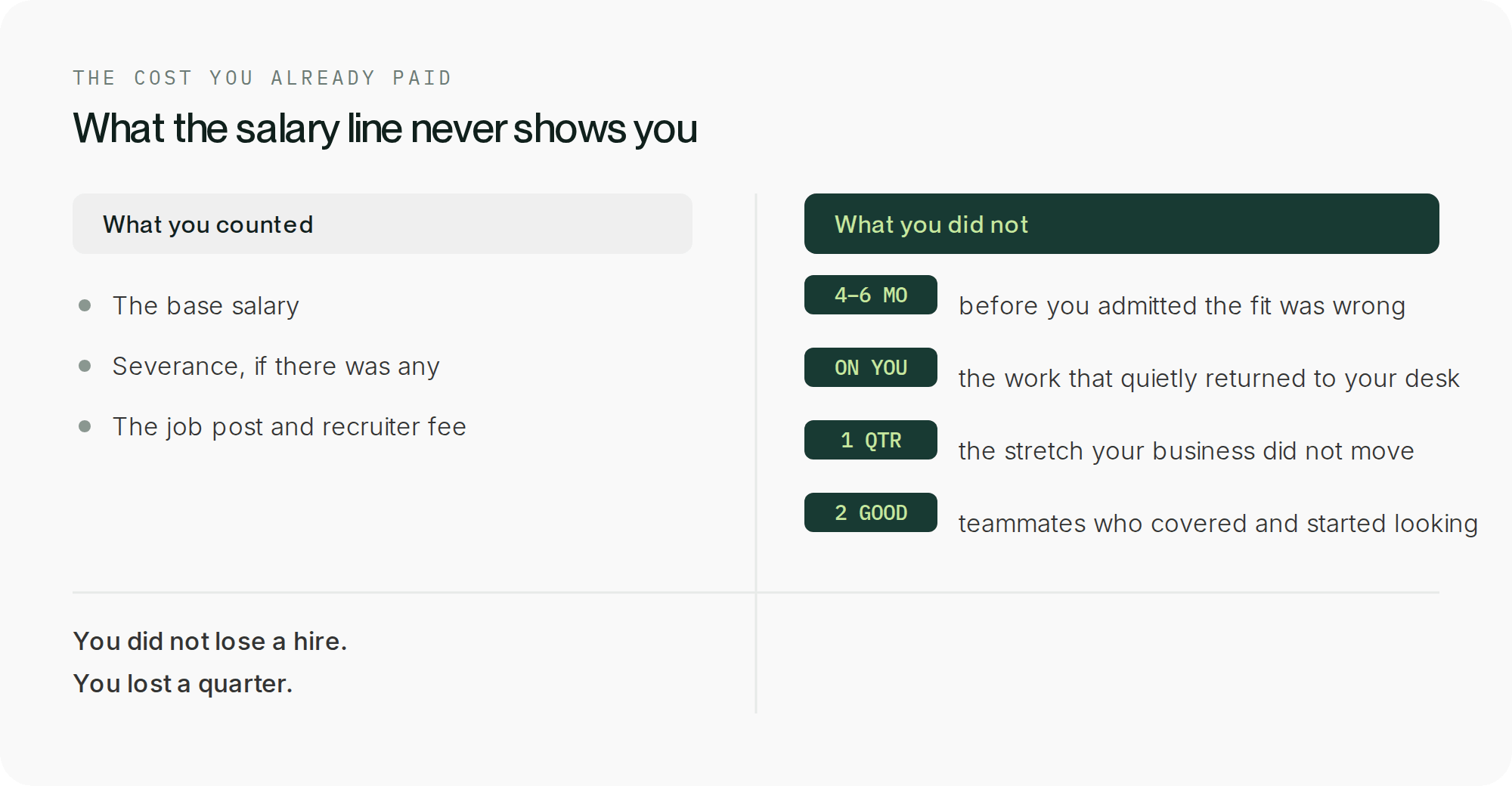
You already know what your last bad hire cost, because you paid it. You counted the salary, maybe the severance, maybe the job post. The harder number is the four or five months before you admitted the fit was wrong, the work that quietly landed back on your desk while you looked for a replacement, and the quarter the business did not move because you were managing a hire instead of building something. That is the cost of a hire you could not verify, and it never appears on the offer letter.
Ask yourself what the real number was. That figure is more convincing than any case study, because you already paid it.
The signals that predict a bad hire
Most failed placements show two or three of these before the thirty-day mark.
- Avoids a live, unscripted conversation. A candidate who resists camera-on screening often avoids accountability once hired too.
- Vague answers about past work. "I am organized and I work independently" without one specific example is a rehearsed line.
- Slow or inconsistent response times during screening. If best-behavior mode is already slow, expect it to get worse after they start.
- No clarifying questions on ambiguous tasks. Someone who takes every instruction at face value will eventually guess wrong on something that matters.
- Defensiveness when given feedback. A preview of how every performance conversation will go later.
- Missed onboarding steps with no proactive flag. A communication gap that will recur under real workload.
- Impressive claims with no verifiable specifics. Worth testing directly, not taking on faith.
What to test yourself, and what to trust to a process
| Test yourself in the conversation | Trust to a structured process |
|---|---|
| How they respond to a live, unscripted question | Baseline skill and tool competency |
| Whether they ask a clarifying question unprompted | Background and reference checks |
| Their reaction to being corrected on a trial task | Working-style and operating compatibility |
| How specific their past-work examples actually are | Structured behavioral screening at scale |
Running your own screen catches the obvious. Running it against a hundred candidates a month is what catches the pattern. That is also why we killed the five-round interview: more rounds of the same conversation do not surface anything the first round missed.
Why communication style breaks more hires than skill
Most failed placements are not skill failures. They are operating-style mismatches that a resume cannot show you. Someone can be technically capable and still fail in your business if how they work does not match how you run it. A personality test does not close that gap either: it describes a person, it does not test them against your conditions.
So matching on skill alone is not enough. Both sides complete a Personal Operating Profile, and every operator is screened against a named set of 13 Vibes: Creative, Collaborative, Proactive, Curious Learner, Strong Communicator, Gets Sh*t Done!, Responsible + Respectful, Adaptable, Responsive, Critical Thinker, Consistent, Problem Solver, Organized. A great operator in the wrong operating environment still fails. The environment is the variable most hiring processes never test.
How we test for these red flags before you ever see a candidate
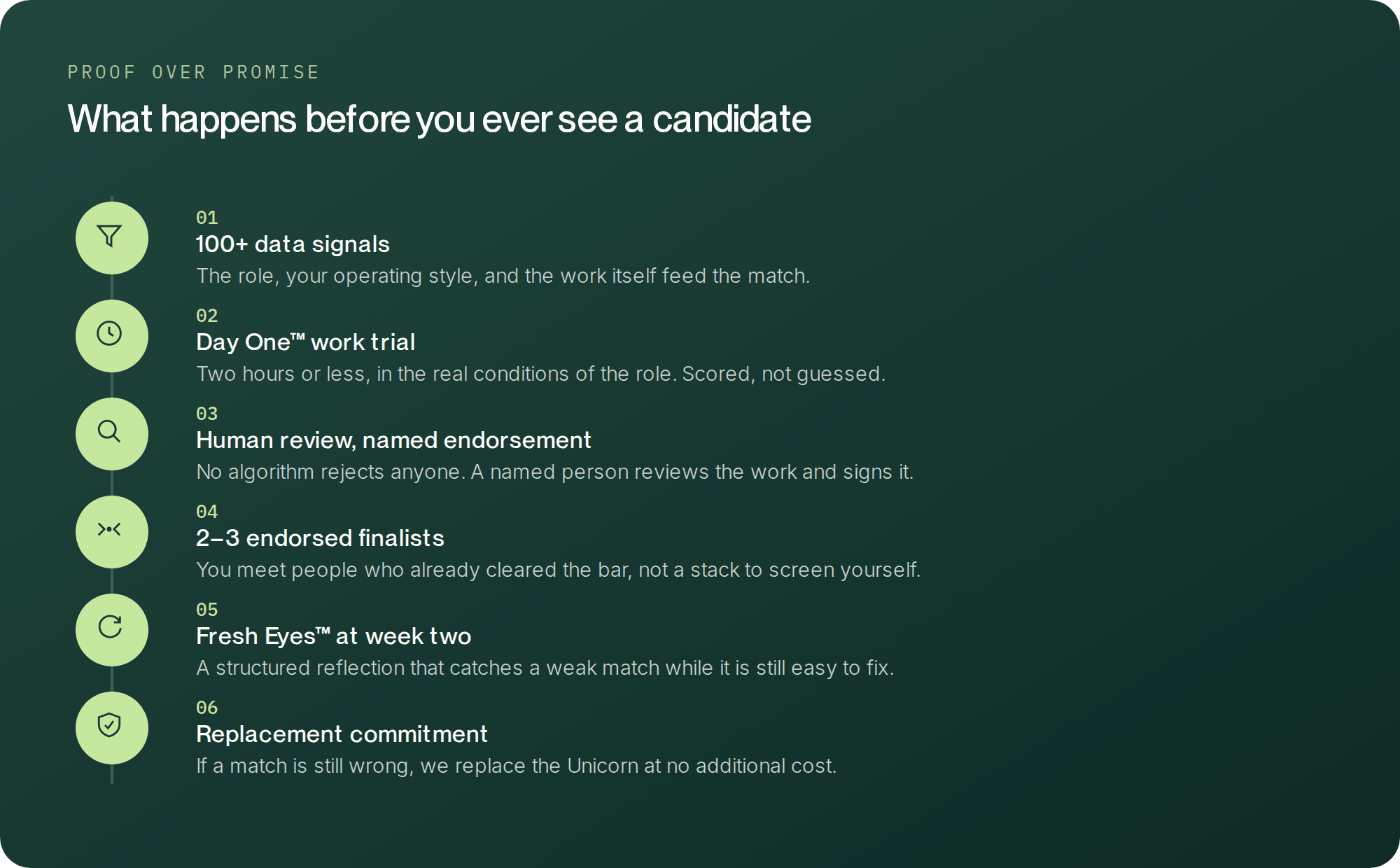
Every match starts with more than a hundred data signals spanning the role, your operating style, and the work itself. From there the candidate completes Day One™, a structured work trial in the real conditions of the role, two hours or less, scored by a human against a rubric built for that specific seat. You see how the person actually performed. We do not keep, use, or ship the work itself.
See the work before you decide on the person.
No algorithm makes the call. A human reviews every submission, and a named person writes the endorsement that reaches you. You meet two or three finalists who already cleared the bar, not a stack of resumes to screen yourself. Most matches are ready in as little as 72 hours. Senior, technical and multi-hat roles take longer, and we scope the timeline honestly before we promise one.
Two weeks in, Fresh Eyes™ checks the match while it is still easy to fix: a structured reflection that catches a weak fit before it becomes a quarter you cannot get back. If the match still is not right after that, we replace the Unicorn, our term for an operator who has cleared this process, at no additional cost.
What these red flags look like in practice
- The vague specific. A candidate says "I am very self-directed" three times and cannot describe one instance of catching a problem before being told about it.
- The defensive correction. Given one small correction on a trial task, they explain why their original approach was fine instead of adjusting.
- The silent slip. A new hire misses a first-week onboarding step, says nothing, and it only surfaces when you check in unprompted.
- The camera-shy screen. A candidate reschedules or avoids the video portion of an interview more than once.
How to build red-flag screening into your own hiring
- Require one live, unscripted conversation. Even ten minutes reveals more than a written application.
- Give a small trial task with one deliberately ambiguous instruction. See whether they ask or guess.
- Correct something minor during the trial. Watch the reaction, not just the fix.
- Ask for one specific, detailed example of past work. Not a general claim.
- Set a thirty-day check-in before you commit further. Catch a silent slip before it becomes a pattern.
Those five steps are a shorter version of the six questions we ask before a hire, scored the same way every time.
How we built this guide
This list draws on the patterns the Assistantly x SupaHumans vetting process tests for across founder-led businesses, from professional services and agencies to trades, property management, and compliance-heavy multi-location operations. Where this piece describes our own process, that is us describing our own process, not research.
The bottom line
The signals that predict a bad hire are specific and they repeat. You can test for most of them yourself with one live conversation and one honest trial task. The rest is what a structured process is for.
The harder question is whether the seat you are hiring for is the one that unblocks the business, or just the thing that annoyed you most last week. That is what the Team Architecture Diagnostic™ is for: we map how the business runs today, show you where it routes through you, and hand back the seat that should come off your plate first.
Twenty minutes on how the business runs today. No profiles, no shortlist, no contract. If it turns out you already know the seat cold, we will tell you so and skip straight to the work.
Proof over Promise.
The Assistantly x SupaHumans Team ⚡️
Common questions
This is how we hire, and it's the standard we hold our own team to. The long version lives in our manifesto. If you're hiring, start here. If you're talent, start here.