Generalist or specialist? The real question is who owns the judgment call
The real signal is not the task list, it is who owns the judgment call inside the work. Here is how to tell which seat your business is actually ready for.

If you typed "generalist vs specialist virtual assistant" into a search bar, you are already comparing two flavors of task list. That is the wrong comparison. The question that actually predicts whether a hire sticks is not what they do, it is who owns the judgment call inside the work.
You already know the load. Maybe it is the invoice that needs your eye before it goes out, the ad account nobody is allowed to touch without asking you first, or the client email that always waits for your specific wording. That thing is still routing through you, and it is the reason you are reading a comparison article instead of running your business.
It is not about the task. It is about who is trusted with the ambiguity.
A generalist operator executes clearly defined, recurring work and escalates anything that is not. A specialist operator is trusted to make judgment calls inside one domain: a specialist bookkeeper flags a discrepancy before you ask, a generalist logs the transaction and moves on.
Founders who mismatch this are usually the ones who end up disappointed in the hire, not because the person was wrong, but because the seat was wrong for the person. It shows up in two directions. Some founders ask a generalist to carry specialist-level ambiguity, expecting inbox-management pay to cover contract-review judgment. Others hire a specialist and hand them generalist busywork that dulls the return on the higher rate. Both mistakes disappear once you separate what needs doing from how much judgment the doing requires.
What did your last mismatch actually cost you? Not the monthly rate. The four months before you admitted it was not working. The work that quietly came back onto your desk. The quarter your business did not move because you were managing a hire instead of building. Most founders can name that number faster than they can name the salary.
Signals you need broad coverage, not depth
- Your task list is wide, not deep. You are bouncing between inbox, calendar, light research, and customer replies, with no single function eating more than a few hours a week.
- You are early stage. At this size, coverage across many small fires matters more than mastery of one system.
- Your workflows are not documented yet. A generalist operator can help you build and stress-test your first SOPs before you know what a specialist seat should even look like.
- Priorities shift week to week. You need someone who moves with you, not someone locked into one lane.
- You are still finding out what to delegate first. A generalist gives you the data to find out, before you commit to a narrower hire.
Signals a function is ready for a specialist
- One function alone is eating 10 or more hours a week, either of your time or of a generalist’s capacity.
- The work has certification, compliance, or licensing weight to it, the kind of judgment a generalist should not be guessing at.
- A mistake in this one lane is expensive, not just slow. Bookkeeping drift, ad spend at scale, contract terms, technical SEO.
- You have already tried folding it into someone else’s plate and watched the quality slip the moment volume went up.
What to delegate to a generalist, and what needs a specialist
| Delegate to a generalist operator | Delegate to a specialist operator |
|---|---|
| Inbox and calendar management | Bookkeeping and financial reconciliation |
| Light research and data entry | Paid media buying and optimization |
| Customer support replies, templated | Contract review and transaction coordination |
| CRM data hygiene | Technical SEO or funnel-specific work |
| Meeting notes and follow-up tasks | Judgment calls that carry domain risk |
How founders typically shop for this
These are marketplaces and staffing platforms, priced by the hour or the month. We are neither. We are talent intelligence and team architecture, matched on proof of work and operating compatibility, not just a task list.
| Option | Best for | Starting price | Standout feature |
|---|---|---|---|
| Upwork | DIY hiring, you vet and manage | $10 to $25+/hr | Full control over sourcing and vetting |
| Magic (GetMagic) | Flexible managed hours, no long commitment | $199 to $540/wk | No long-term contract required |
| Prialto | Fractional executive-admin support | About $1,500/mo per 55-hour unit | Team-based backup coverage |
| Wing Assistant | Budget-conscious dedicated support | $699 to $999/mo | Lower entry price point |
| SupaHumans | Founders who want judgment fit proven before they hire, not discovered after | Starts at $2,800/mo | Day One™ work trial, human-scored, replacement covered |
Rates checked September 2026 from each provider’s published pricing. Confirm current numbers directly with them before deciding: monthly and hourly plans change often.
A title does not tell you who will flag the anomaly
Two candidates can carry the identical "specialist bookkeeper" title and differ enormously in whether they flag a problem before you ask or wait to be told. The title says what someone was trained to do. It does not say how they will behave the first time something does not match the pattern they expected. That is a different gap for a generalist role than a specialist one: a generalist’s judgment gets tested across variety, a specialist’s gets tested for depth in one lane. Judging that from a resume is guessing with extra steps. We do not decide from a resume.
How we test for judgment fit before you see a profile
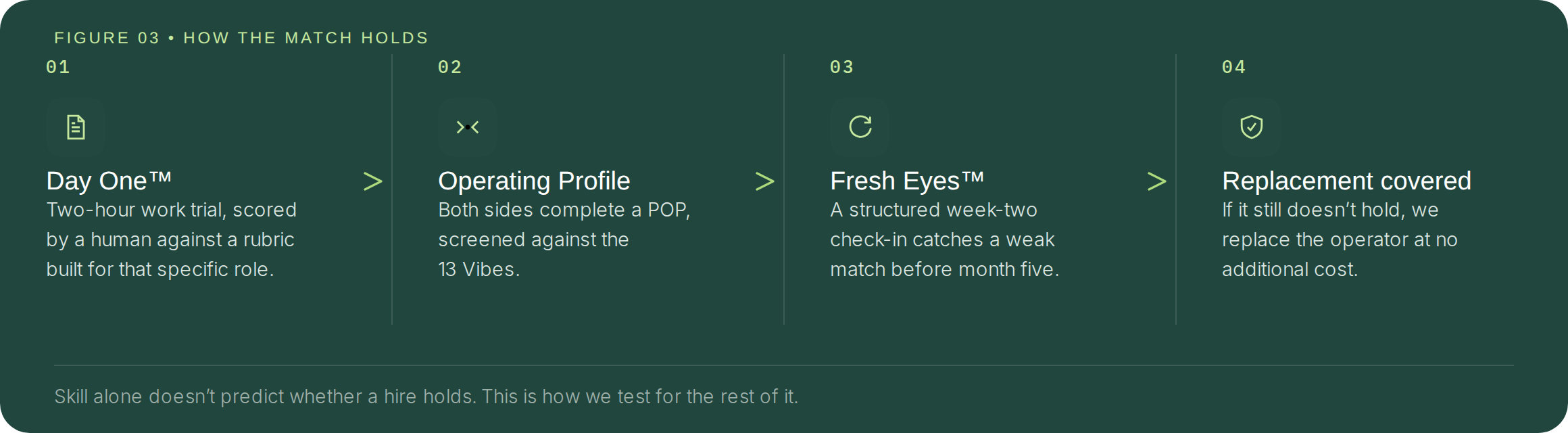
Every operator, generalist or specialist track, completes Day One™: a structured work trial in the real conditions of the role, two hours or less. A human reviewer scores it against a rubric built for that specific role, and a named person on our team writes the endorsement that reaches you. No algorithm rejects anyone. You see how the person actually performed before you decide on them. You do not keep, use, or ship the work itself.
Skill alone does not predict whether a hire holds. Both sides also complete a Personal Operating Profile, and we match how the operator actually works against how you actually run your company at this stage of the business. Every operator is screened against the 13 Vibes, our named trait set: Creative, Collaborative, Proactive, Curious Learner, Strong Communicator, Gets Sh*t Done!, Responsible + Respectful, Adaptable, Responsive, Critical Thinker, Consistent, Problem Solver, Organized. A great operator in the wrong operating environment still fails, which is why we screen for both instead of stopping at skill.
This is more upfront work than posting a job and reading resumes. That is the point, not an apology. It is why the match holds. In as little as 72 hours we can have a generalist match in front of you. Senior, technical, and multi-hat specialist roles take longer, and we scope the real timeline with you before we promise one.
At week two, Fresh Eyes™ gives us a structured checkpoint: the operator tells us what is working, what is not, and what they would change, so a weak match gets caught early instead of found in month five. And if a match genuinely does not work, we replace the operator at no additional cost. We do not lead with that, because a guarantee in a hook signals doubt. We mention it because our process is built to be right, and when we still get it wrong, we own it instead of handing you the fallout.
How to decide, before you hire either one
- List every recurring task eating your time this month. Tag each one wide-and-shallow or narrow-and-deep.
- If one function alone eats 10 or more hours a week, that is your specialist signal.
- If the list stays wide with no function dominating, start broad.
- Reassess every 90 days. A generalist seat usually reveals which specialist seat comes next.
- Match on how the person works, not just the task list, whichever track you choose.
Once you know which one you need, matching well matters more than deciding fast. Assistantly x SupaHumans starts at $2,800 a month. Every operator, generalist or specialist, is matched on proof of work and operating compatibility, not just a task list. Fresh Eyes™ checks the fit at week two, and if a match genuinely does not hold, we replace the operator at no additional cost.
Common questions
This is how we hire, and it's the standard we hold our own team to. The long version lives in our manifesto. If you're hiring, start here. If you're talent, start here.