Fractional chief of staff alternatives: what founders should actually be comparing
If you are searching for this title, something specific already happened. Here is what the role actually covers, why the fractional version fails structurally, and which seat should come off your plate first.

A project sat between two departments for three weeks and nobody escalated it. The monthly report got built by you, at night, again. A client waited four days for an answer because it needed your sign-off and you were in a different room. A new location or service line opened, and every decision about it still lands in your inbox.
The title is not the problem. The title is the shape you have given a problem nobody has diagnosed yet.
This guide covers what a chief of staff actually does, why the fractional version fails more often than founders expect, and what to compare before you commit to anyone. You did not build this to become the thing it cannot run without.
What does a fractional chief of staff actually do?
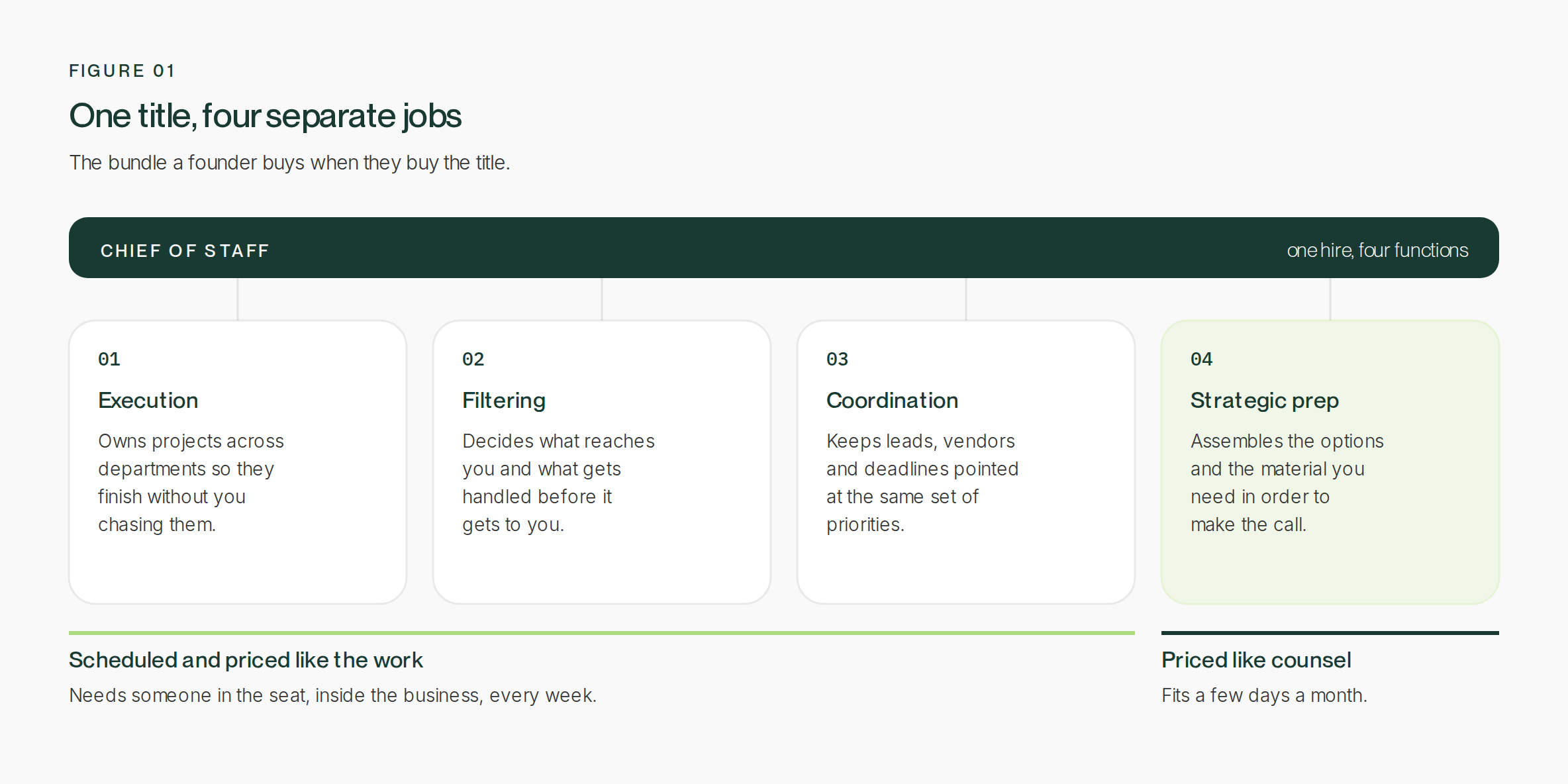
A chief of staff sits close to the owner and turns intent into execution. In practice that is four separate jobs wearing one title.
- Execution. Owning projects across departments so they finish without you chasing them.
- Filtering. Deciding what reaches you and what gets handled before it does.
- Coordination. Keeping department leads, vendors, and deadlines pointed at the same set of priorities.
- Strategic prep. Assembling the options and the material you need in order to make the call.
A fractional chief of staff covers some subset of those a few days a month, usually across a small book of clients.
Why the title is a bundle, and why that matters
The four jobs are priced and scheduled differently, which is the practical reason to separate them.
Strategic counsel is bought like counsel. A few days a month is a sensible shape for it, because the work is episodic and the value sits in the judgment.
Execution, filtering, and coordination are bought like the work. They happen daily, they happen in the details, and they need someone in the seat every week. Buying them a few days a month gets you a calendar slot where you needed an owner.
Founders who buy the whole bundle when they needed the execution half pay for capacity they never use. Founders who buy execution when they actually needed counsel end up saying the hire “is not thinking strategically enough,” about a seat they never staffed for strategy.
Why does a fractional chief of staff fail more often than founders expect?
Because most of those hires fail structurally rather than personally.
Big-company careers reward people who can explain operations in a room. That is a communication skill, and it interviews beautifully. Having actually run the thing is a different qualification.
Then there is the word fractional. Fractional means they visit. You cannot repair an operating system you are never inside when it breaks, and it always breaks on a Tuesday afternoon between visits. The person who can fix how your quote approvals work is the person who has sat inside them for six weeks and can feel where they go wrong.
They can talk operations. They have just never done them. The plan got cheap. Installing it did not.
Laith Masarweh
That is the part worth being honest about before you compare anything. The market has plenty of people who will hand you a plan. Very few of them will be there on the Tuesday.
What did the last one actually cost you?
Before you compare options, price the last attempt properly. Most owners count the retainer or the salary and stop, because those are the only two numbers on paper.
The rest of the bill is real, and it is yours to add up.
- How many months passed between your first private doubt and the day you said it out loud?
- Which parts of that role came back onto your own plate, and are any of them still there?
- Who covered the gap, and did that person start looking?
- Did any customers notice before you did?
- What did the quarter do while you were managing a hire instead of building?
- What did you decide about the next hire because of this one? Too cautious, or too late?
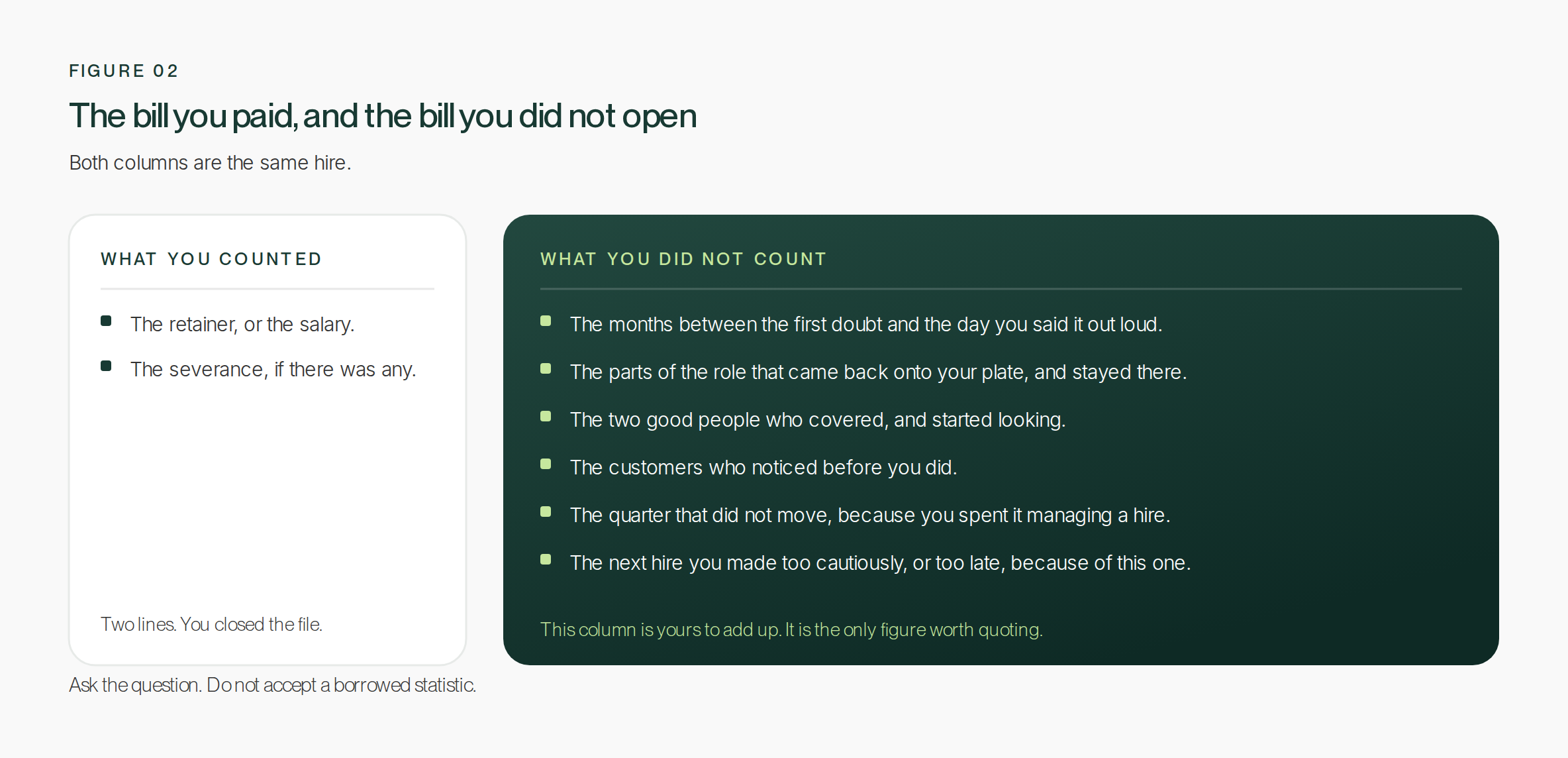
That total is the only cost-of-a-bad-hire figure anyone should be quoting at you. It is more persuasive than any borrowed statistic, and it is the number that should set your standard for evidence from here on.
What are the real alternatives to a fractional chief of staff?
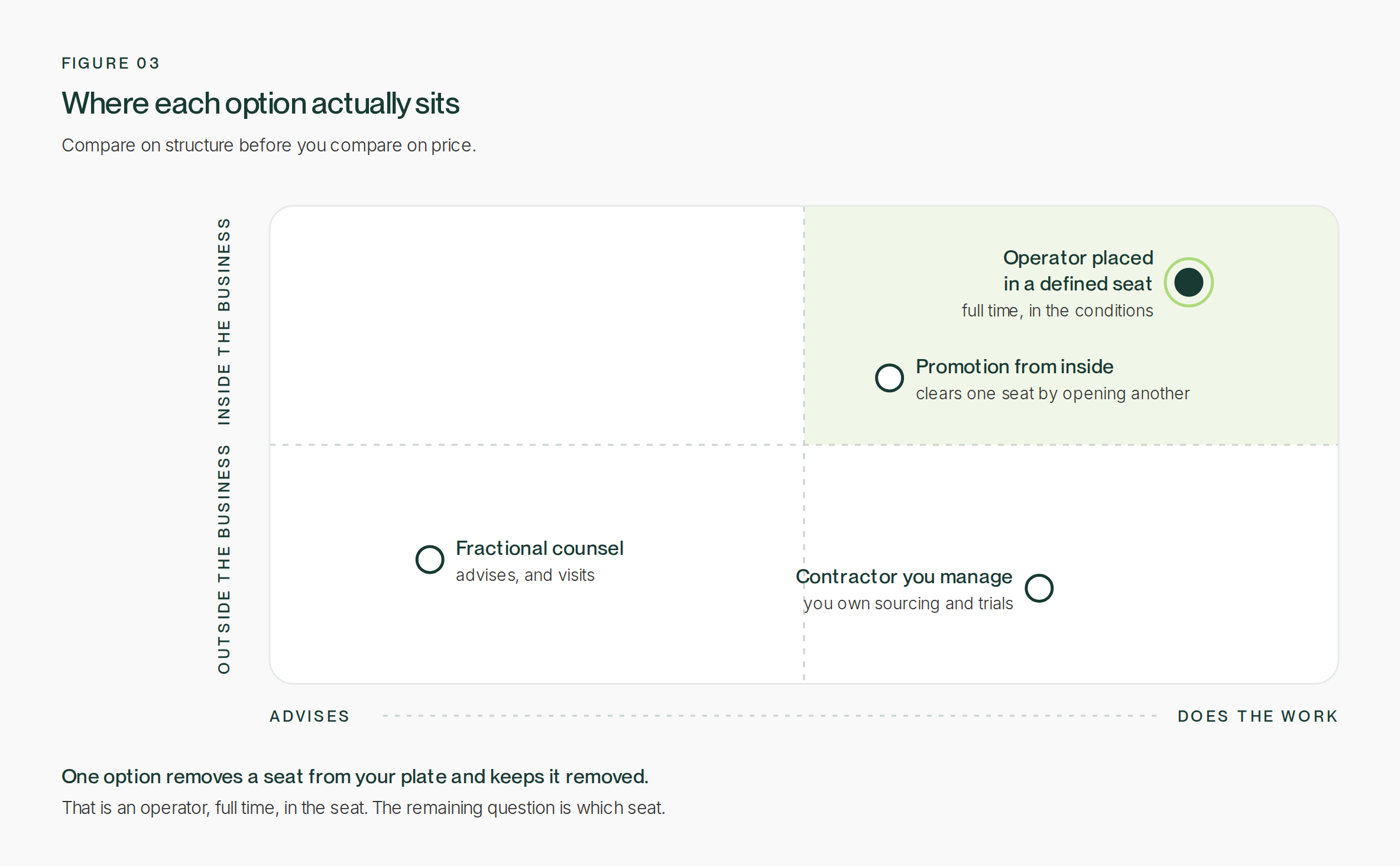
Compare on structure before you compare on price. Two questions sort every option: does this person advise or do the work, and are they inside the business or outside it.
Fractional strategic counsel. Advises, and visits. Genuinely useful when the thing you are missing is judgment on a decision you make twice a year. Not the answer when what stalled was a project nobody owned.
A contractor you source and manage yourself. Does the work, from outside. You keep full control, and you also keep the sourcing, the trial design, the reference checks, and the management. That is the cost people forget to price, because it gets paid in your hours rather than in invoices.
Promoting from inside. Does the work, from inside, with the context and the trust already built. The trade is that clearing one seat opens another. You still have to fill the job they left, and you are betting on untested capability in a seat they have never held.
An operator placed into a defined seat. Does the work, from inside, full time, in the real conditions of the role. Nothing new opens behind them. The trade is that you are trusting somebody else’s judgment about a person, which is only reasonable if they can show you their evidence.
Three of those four leave you roughly where you started. Counsel hands you a plan and leaves. A contractor takes the work off your desk and puts the managing of it back on. A promotion moves the bottleneck rather than removing it.
One option takes a seat off your plate and keeps it off: an operator, full time, in the seat, inside the real conditions of your business. That is the answer for almost every founder who searches for this title. What it does not tell you is which seat, and that is the decision underneath the search.
What should you hand off, and what stays with you?
| Hand to an operator in the seat | Keep with you, or with strategic counsel |
|---|---|
| Building and formatting the board deck or the monthly report | The recommendations inside it |
| Project tracking and cross-team follow-up | Setting company-wide priorities |
| Filtering the inbox, the calendar, and the escalation queue | Personnel and org-design decisions |
| Meeting prep, notes, and the follow-through afterward | High-stakes external meetings where you are the relationship |
| Vendor coordination, compliance calendars, multi-location logistics | Long-range planning ownership |
The right-hand column is short on purpose. Most of what has you working past eight sits on the left.
How do you know a person can actually run the seat?
Hold every option in this guide to the same standard, including ours. Anyone can tell you they have great people. The question worth asking is how they know.
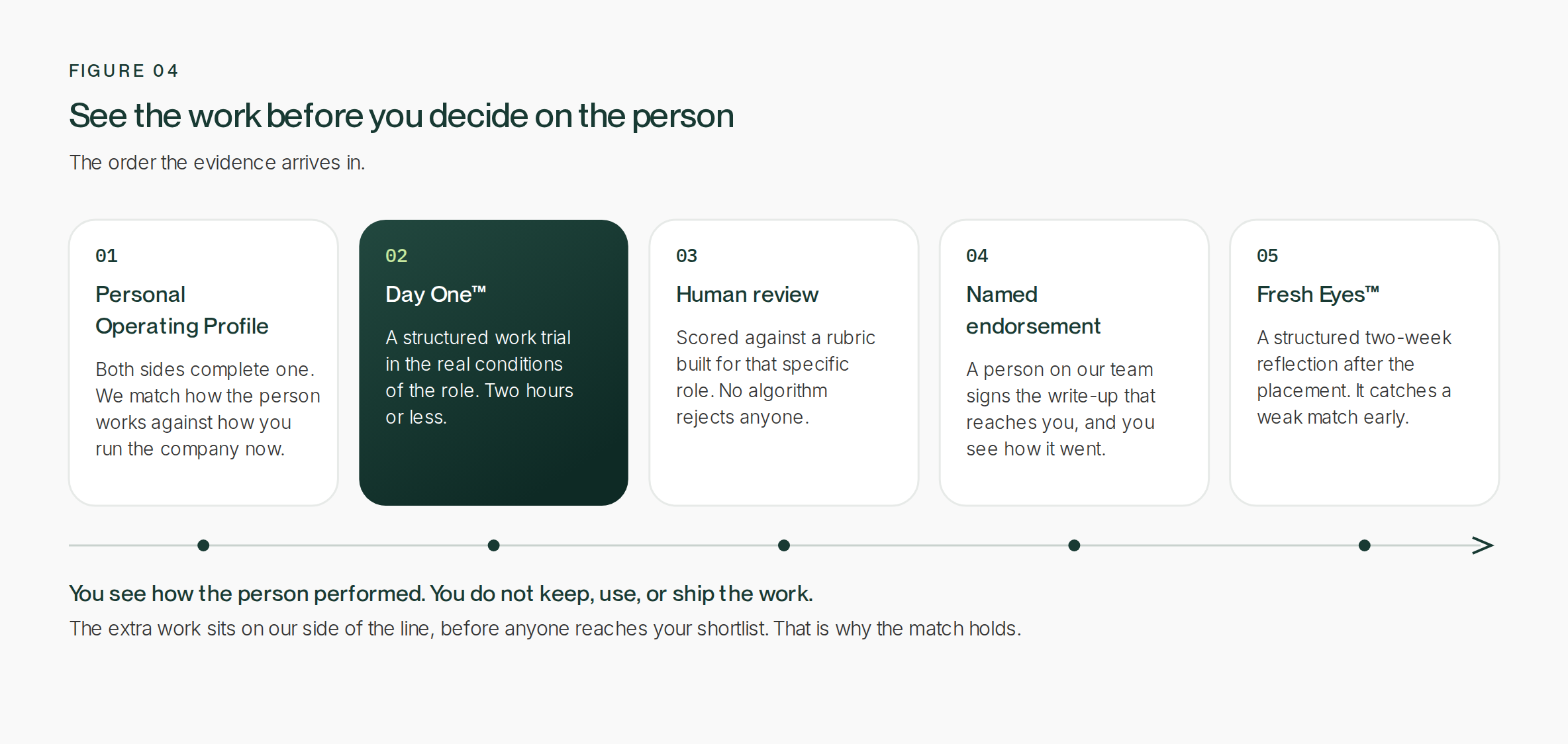
Here is our mechanism, in the order the evidence arrives.
- Both sides complete a Personal Operating Profile. We match on proof of work plus operating compatibility, not on skill alone. We compare how a person actually works against how you actually run your company at this stage of it. A great operator in the wrong operating environment still fails, which makes compatibility a structural question rather than a personality one.
- The candidate completes Day One™. A structured work trial in the real conditions of the role, two hours or less. You see how the person performed, because that evidence is how they get hired. You do not keep, use, or ship the work.
- A human scores it against a rubric built for that role. There is no AI interviewer anywhere in this. No algorithm rejects anyone, and a named person on our team writes the endorsement that reaches you. We do not decide from a resume, and neither should you.
- Every operator is screened against the 13 Vibes. Creative, Collaborative, Proactive, Curious Learner, Strong Communicator, Gets Sh*t Done!, Responsible + Respectful, Adaptable, Responsive, Critical Thinker, Consistent, Problem Solver, Organized. It is the filter that catches people who can do the tasks but cannot do the job.
- Fresh Eyes™ runs at week two. A structured reflection after placement where the operator tells us what is working, what is not, and what they would change. It is how a weak match gets caught early instead of in month five.
That is more work upfront than most processes ask for, and we are not going to apologize for it. It sits on our side of the line, before anyone reaches your shortlist, and it is the reason the match holds.
If a match does not work anyway, we replace the Unicorn at no additional cost. A Unicorn is our term for an operator who has cleared the standard. The process is built to be right, and sometimes we still get it wrong, so we own that rather than making you absorb it. Fresh Eyes™ is why it rarely comes to that.
How fast can a seat actually be filled?
For a well-defined role where the profile is already in our pool, we can have someone in the seat in as little as 72 hours. Senior, technical, and multi-hat roles take longer, and we scope the timeline before we promise you one.
How do you decide which option fits?
- Write down the last five things that waited on you this month. The real ones, not the job description.
- Sort them into the four functions: execution, filtering, coordination, strategic prep.
- If four of the five are execution, filtering, or coordination, you are hiring an operator into a defined seat. That part is settled. The open question is which seat.
- Decide what evidence you will require before you commit to a person. Write that down too, because a good shortlist will talk you out of it.
- Map the whole org before you fill one chair. Hiring in the wrong order is what makes the second hire harder than the first.
If you do not know which seat comes first, you are in the majority. Searching for a job title is how that uncertainty usually shows up. That is what the Team Architecture Diagnostic™ is for. We map how your business runs today, show you exactly where it routes through you, and hand back the org you should have: the roles, the sequence, and which seat comes off your plate first. You keep the architecture whether or not you ever hire through us.
The bottom line
For almost every founder who searches this term, the answer is an operator in a defined seat. Full time, inside the business, in the real conditions of the role, with evidence of the work before you commit to the person.
Buying a title is the easy version of this decision. Working out which seat comes off your plate first is the useful one.
Twenty minutes on how the business runs today, and you leave with the map: the org you should have, the sequence, and which seat comes off your plate first.
Proof over Promise.
The Assistantly x SupaHumans Team ⚡️
Common questions
This is how we hire, and it's the standard we hold our own team to. The long version lives in our manifesto. If you're hiring, start here. If you're talent, start here.