What to Ask Before You Hire: Six Questions That Predict Whether an Operator Lasts
The interview is where most hires fail, months before anyone admits it. Six questions to ask every candidate, the step most owners skip, and what the last mishire actually cost you.

Every quote still comes back to you for approval. Every escalation lands in your inbox before it lands anywhere else. You have hired at least once to change that, and you are still the last set of eyes on everything.
You did not build this to become the thing it cannot run without.
So if the last hire did not work out, it is worth being precise about when it failed. Not month five, when you finally said it out loud. It failed in the interview, in a pleasant thirty-minute conversation that measured how someone presents and told you almost nothing about how they perform. Hiring is the last part of business still run on vibes and a resume.
Below is the version of that conversation that predicts something: six questions, the one step most owners skip, and what to do with the answers.
What vetting actually means
Vetting means testing how a candidate performs on the work you need done. Not how well they perform in a call about the work.
Most hiring stalls right here, because nobody was ever taught the difference. Forbes reports that University of Phoenix research found roughly one in four non-HR hiring stakeholders receives no interview training at all. Which means most founders are running the same unstructured conversation they have always run and counting it as due diligence.
You can leave a call impressed by a candidate’s warmth, their fluency, their confidence, and still have no evidence that this person can hold a task list without supervision, flag a mistake before it reaches a client, or make a judgment call at six on a Friday when you are unreachable.
Likability and capability are measured by different questions. Most interviews only ask the first kind.
What the last one actually cost you
Before the questions, the arithmetic. When a hire fails, most owners count one number: the salary, maybe the severance. That is the smallest line on the bill.
Here is the rest of it. Answer for your own business rather than taking a figure from an article.
- How many months passed between the moment you knew and the moment you admitted it?
- Which of their responsibilities quietly came back onto your plate, and are they still there?
- Who else on your team covered, and did that person start looking?
- Which customers noticed?
- What did not move that quarter, because you spent it managing a hire instead of building?
- What did this one do to the next hire: too cautious, too slow, or both?
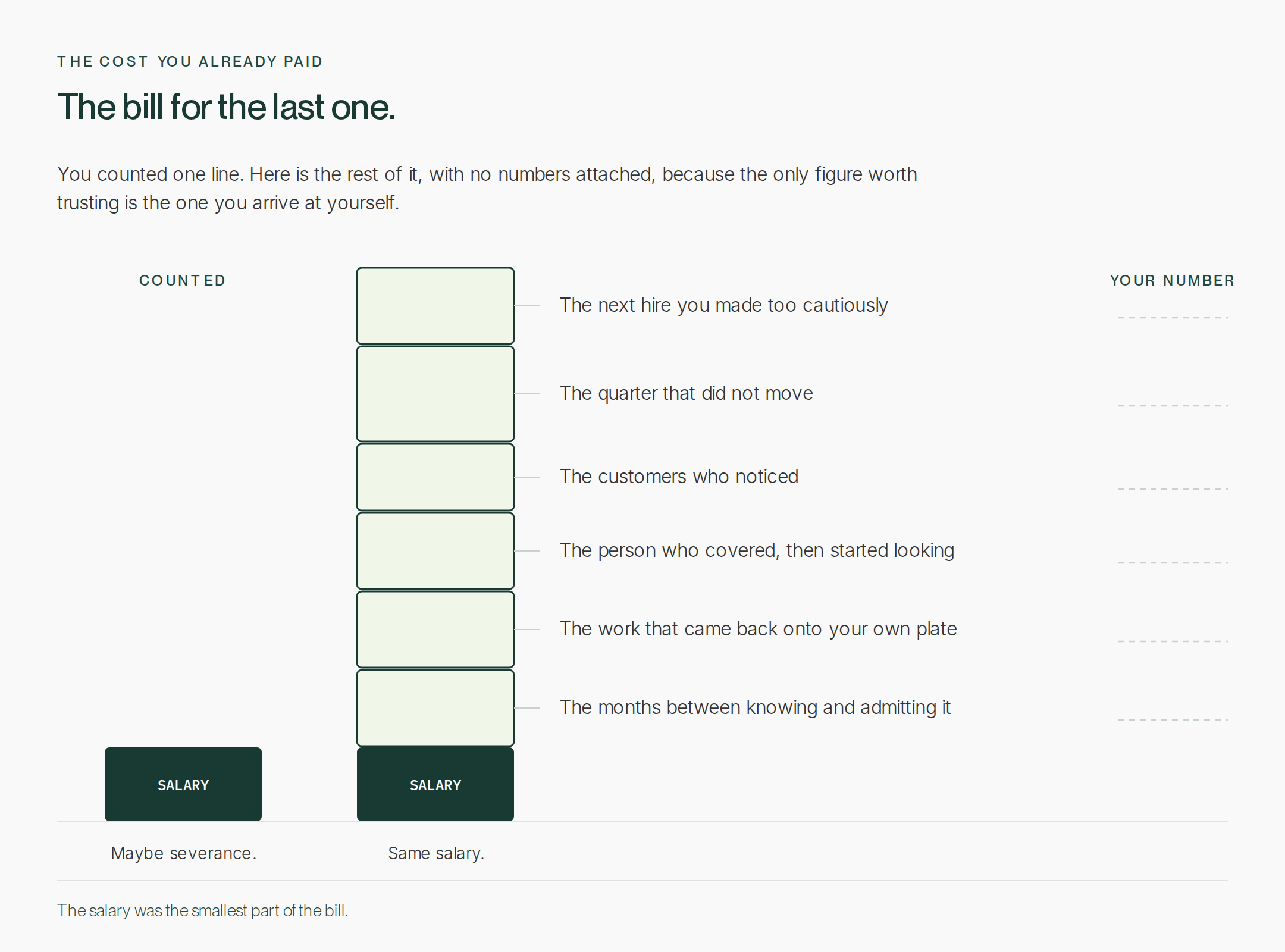
Nobody needs a statistic here. Owners who work through that list land on a number several times larger than the salary, and it is the only number worth trusting, because it is theirs.
You did not lose a hire. You lost a quarter.
The six questions
Ask all six, in the same order, of every candidate, and write down the answers. Comparability is the whole point. A question you only ask the candidate you already like is not a screen.
- Walk me through the last time a client or a manager changed their mind on you mid-task. Tests adaptability against a real event rather than a hypothetical. Someone who has done the work tells you a specific story. Someone who has not describes a policy.
- What is your process when you hit something you do not know how to do? The best single predictor of whether you can hand this person ambiguous work. You are listening for whether they escalate, guess, or quietly stall.
- Show me one piece of work you are proud of, and one you would do differently. Only somebody who has actually shipped has a real answer to the second half.
- What are your working hours in my time zone, not yours? Gets a concrete commitment instead of “flexible,” which becomes a missed handoff in week two.
- How do you tell a client you made a mistake? This answer tells you more about reliability than anything on a resume.
- What would make you leave this role in the first ninety days? Surfaces the mismatch on pay, hours, or scope before it costs you a second search.
None of the six is the important one. They work as a set, because each tests something different: adaptability, escalation habits, real work quality, availability, honesty about mistakes, and expectation alignment. Drop one and you lose that signal.
Why structure beats a strong first impression
A first impression tells you how somebody presents. A structured process tells you how they perform, and the research on this is not close. The Society for Industrial and Organizational Psychology, summarizing the 2022 re-analysis by Sackett and colleagues, reports that structured interviews are the strongest single predictor of job performance in the entire body of hiring research, ahead of cognitive ability testing. The advantage comes from one specific thing: asking every candidate the same job-relevant questions and scoring the answers against a consistent standard, instead of trusting the read in the room.
Which points straight at the step most owners skip. A structured interview is a much better conversation. It is still a conversation. The strongest evidence available to you is not what someone says about the work. It is the work.
Skill was never the thing that broke your last hire
You have probably hired somebody who could genuinely do the tasks, and it still did not hold. That rarely comes down to luck, and it is rarely a character problem on either side. What broke was compatibility, and compatibility is structural.
The right operator for a $2M company with three staff is not the right operator for a $6M company across two locations. One of them needs a person who will build the process that does not exist yet. The other needs a person who will hold a process that already does, across sites, without drifting. Same skill set on paper. Opposite jobs. A compliance-heavy business adds a third version of the same problem, because there the cost of a judgment call made casually is not a bad week, it is a finding.
Most hiring treats fit as a personality question. It is a structural one, and it is the axis almost nobody measures.
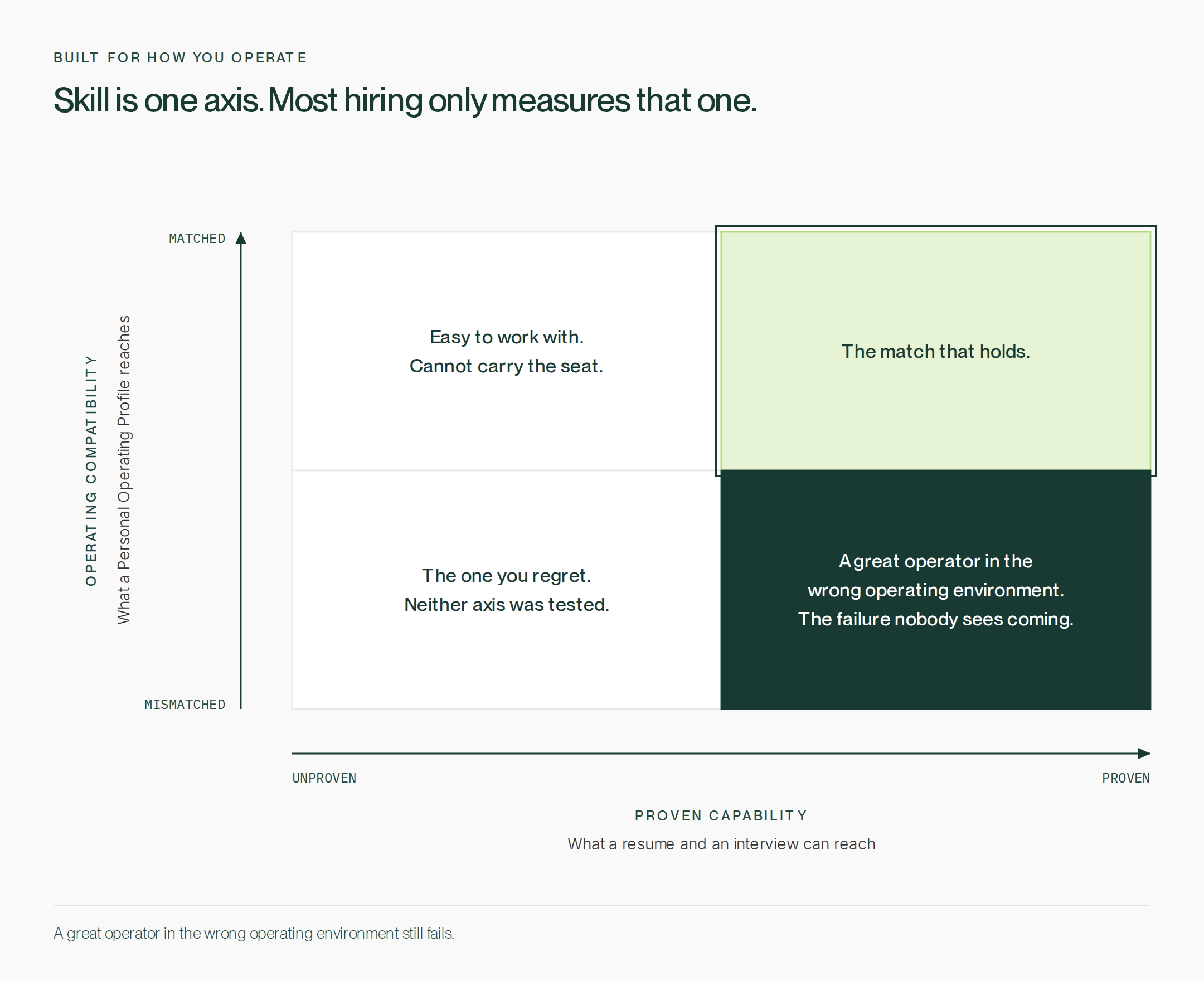
A great operator in the wrong operating environment still fails.
How we decide, and what you get to see
Every firm in this category will tell you they have great people. Neither of us can check it, which is the actual problem with the category. So here is the machinery instead.
- Both sides complete a Personal Operating Profile. Yours and theirs. We match how the person actually works against how you actually run your company at this stage of the business, rather than against a skill list.
- Every operator is screened against the 13 Vibes. Our named trait set. It is the screen that filters out the people who can do the tasks but cannot do the job. The ones who clear it become Unicorns, our name for an operator who has met the standard.
- They complete Day One™. A structured work trial in the real conditions of the role, two hours or less, scored by a human against a rubric built for that specific role. You see how the person performed, because that evidence is how they get hired. You do not keep, use, or ship the work.
- A human reviews every submission. No AI interviewer. No algorithm rejects anyone. A named person on our team writes the endorsement that reaches you, and puts their name on it.
- We do not send resumes. We do not decide from one, and we would not ask you to. What arrives instead is the work, how the person operates day to day, and why a named person endorsed them.
- Fresh Eyes™ at week two. A structured reflection after placement, where the operator tells us what is working, what is not, and what they would change. It is how a weak match gets caught in week two instead of month five.
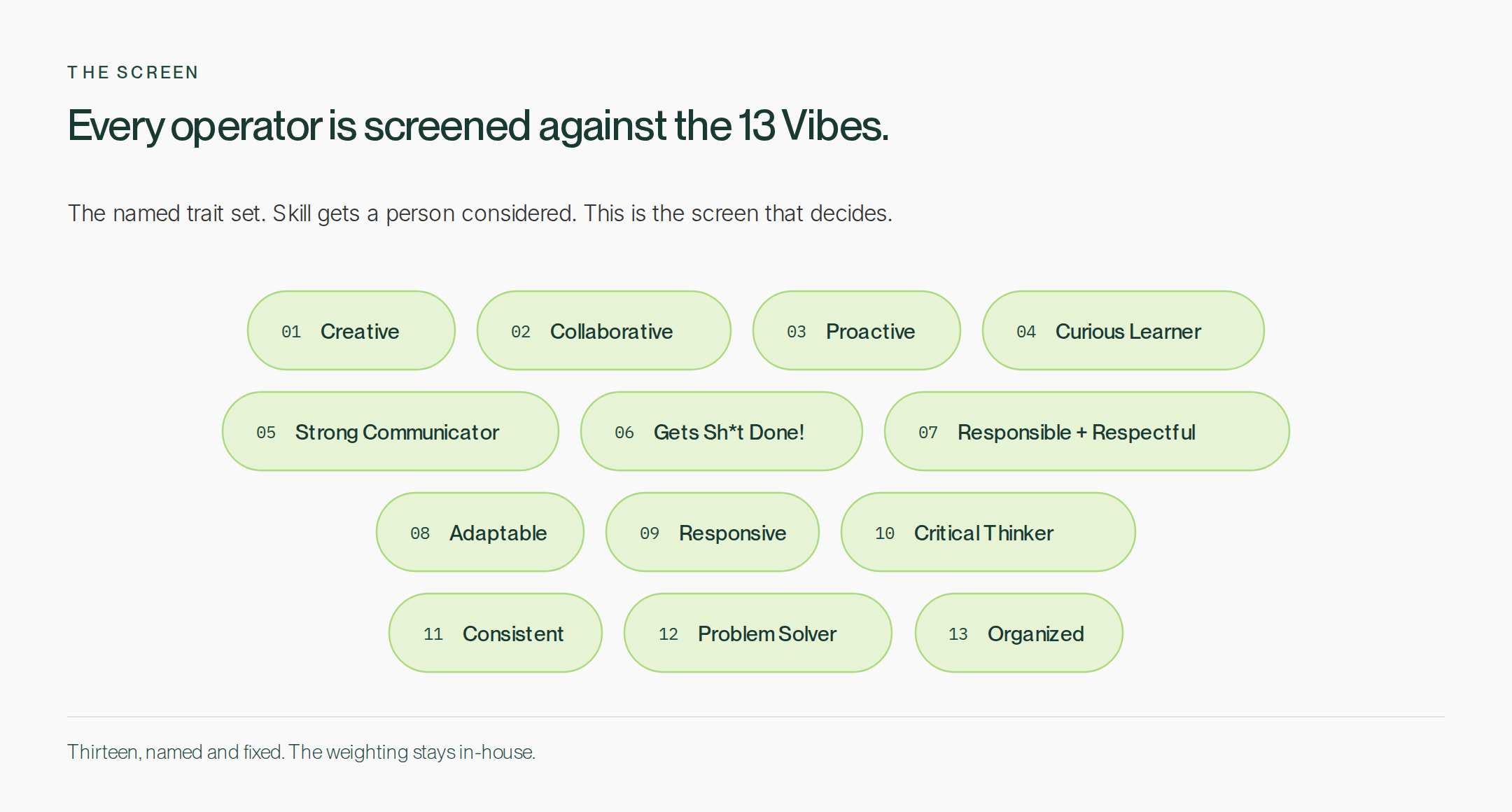
That is more work than this category is used to doing before anyone reaches a shortlist, and it is the reason the match holds. For a well-defined role where the profile is already in our pool, we can have someone in the seat in as little as 72 hours. Senior, technical, and multi-hat roles take longer, and we scope the timeline before we promise you one.
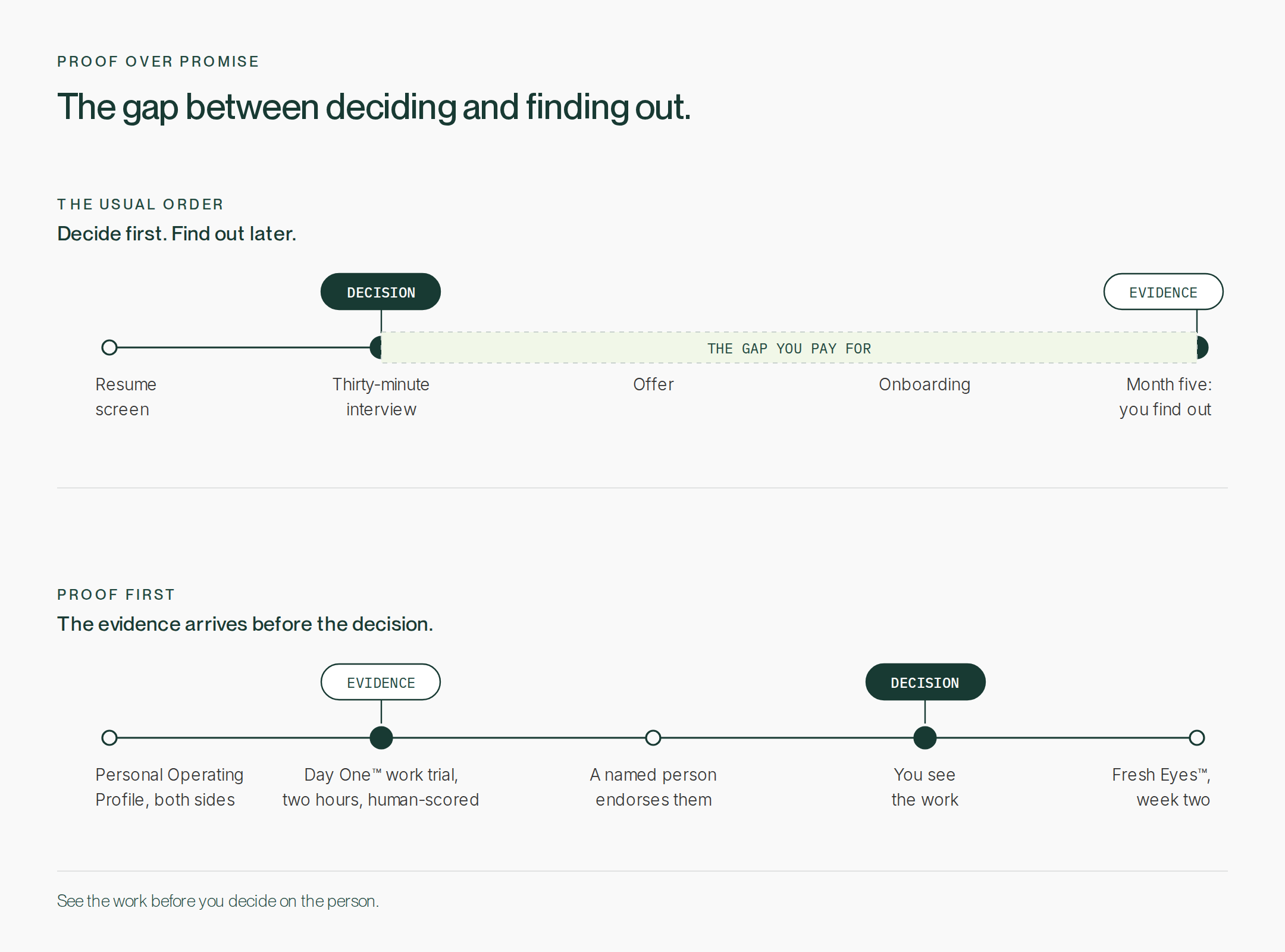
If a match does not work, we replace the Unicorn at no additional cost. Our process is built to be right, and sometimes we still get it wrong, so we own that rather than asking you to absorb it. Fresh Eyes™ at week two is the reason it rarely comes up. On windows, limits, and conditions, ask us directly and you will get a straight answer from a person rather than a footnote on a marketing page.
See the work before you decide on the person.
Laith Masarweh
If you would rather run this yourself
Plenty of owners do, and it works. This is the shape of it.
- Write down the three to five things this person will actually do in a normal week. Screen against those, not against a generic skill list.
- Ask the six questions above in every interview, in the same order, and score them against a standard you wrote down before the first call.
- Assign a short, real, paid piece of work before you commit. Evaluate the output against your own standard, not against whether they tried.
- Confirm the overlap hours in your time zone, in writing, before the offer.
- Set the thirty, sixty and ninety day checkpoints before day one, so “working out” has a dated answer instead of a feeling.
That process is sound. It costs you the hours to build it, run it, and score it, every time you hire. Most owners in the $3M to $7M range are trying to buy those hours back, which makes running your own screen a strange place to spend them.
The one thing the six questions cannot tell you
They test whether a person can do a role. They cannot tell you whether it is the right role.
Most owners describe the symptom, which is whatever annoyed them most last week. The seat that actually unblocks the business is usually one layer behind it: not the inbox, but the approval step feeding the inbox. Hire well against the wrong seat and you end up with a good operator, a real cost, and the same ceiling.
That is what the Team Architecture Diagnostic™ is for. We map how your business runs today, show you exactly where it routes through you, and hand back the org you should have: the roles, the sequence, and which seat comes off your plate first. Placement is the step after, and by then it is obvious.
The bottom line
Most hiring mistakes trace back to the same place: a conversation that measured how somebody presents. Ask the six questions, score them the same way every time, and pay for a real piece of work before you commit. That catches most bad matches before they cost you anything.
Then answer the harder question, which is whether the seat you are hiring for is the one that unblocks the business. That one is worth twenty minutes.
Twenty minutes on how the business runs today. No profiles, no shortlist, no contract. If it turns out you already know the seat cold, we will tell you so and skip straight to the work.
Proof over Promise.
The Assistantly x SupaHumans Team ⚡️
Common questions
This is how we hire, and it's the standard we hold our own team to. The long version lives in our manifesto. If you're hiring, start here. If you're talent, start here.