How to hire an AI-fluent operator for your business
What AI fluency looks like inside real work, the signals that separate it from tool use, and how to test for it before you hire.

Most founders already have someone on the team using AI. Few have tested whether that person is actually fluent in it, or just fast with it.
Your business already runs on AI somewhere. Someone is drafting emails with it, summarizing calls with it, pulling research with it. The real question is not whether they use it. It is who catches what it got wrong before a client sees it. Right now, that is probably you.
You have likely already paid for a hire who could not do that. Not the salary. You counted that. What is harder to count: the weeks you spent rewriting drafts instead of running the business, the client email you caught two minutes before it sent, the ones you did not catch in time. What did the last mismatch actually cost you?
This is a screening guide, not a pitch. What AI fluency actually looks like, how to test for it yourself in twenty minutes, and how we test for it before you ever see a profile.
What is an AI-fluent operator?
An AI-fluent operator uses AI tools inside real, daily work: drafting, research, data cleanup, scheduling logic, while still verifying facts, protecting confidential information, and applying judgment before anything ships. The skill is not the tool. It is knowing when to trust it and when not to.
Using AI versus being AI-fluent
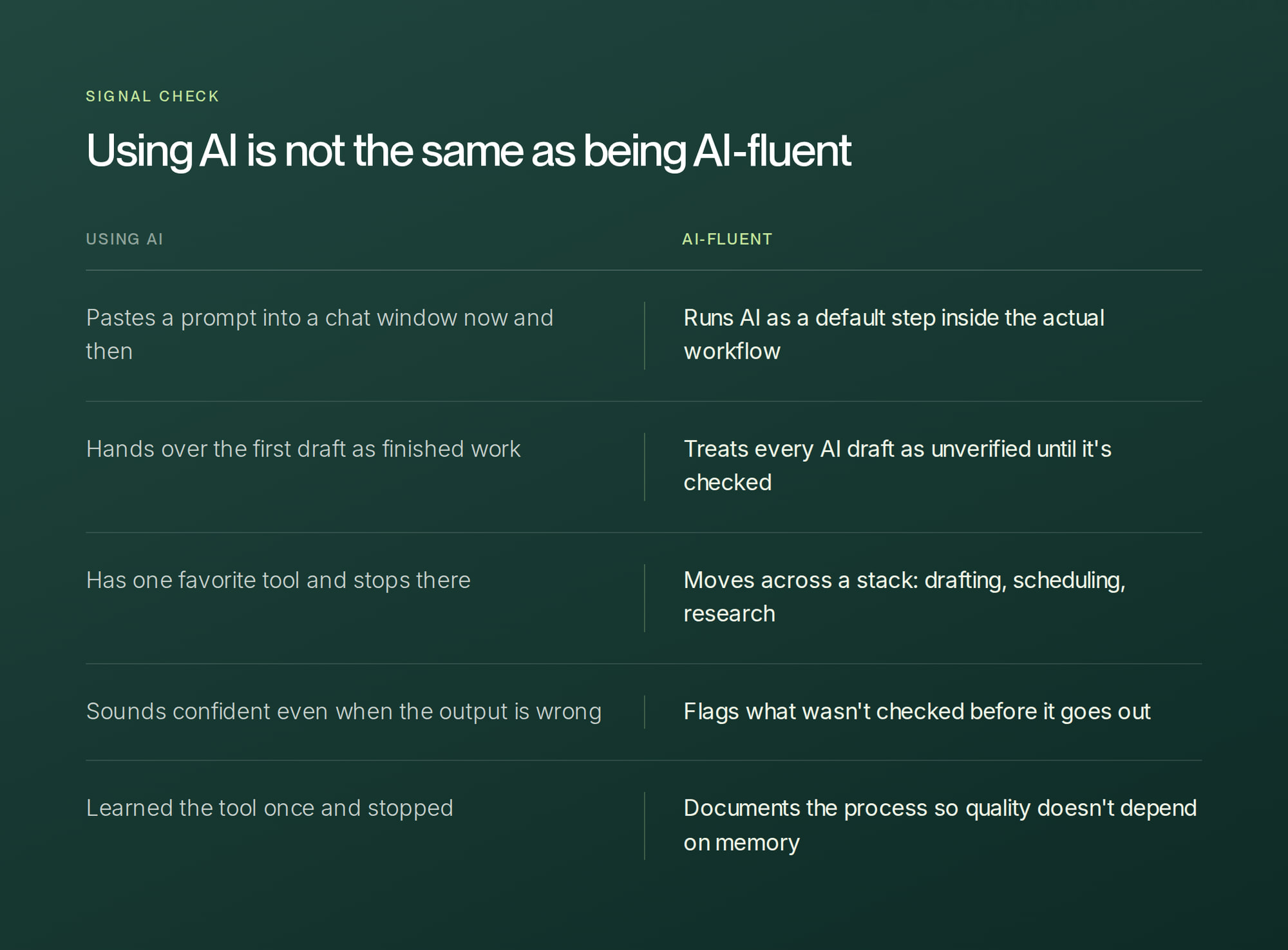
Three in four knowledge workers already use AI at work in some form, per Microsoft and LinkedIn's most recent workforce data. Fewer organizations have caught up with them: separate 2026 workforce research put the share of organizations that consider their AI use fully mature at roughly one in a hundred. The gap is not about tool access. It is about judgment.
ICIMS' 2026 workforce research found something similar on the hiring side: most job seekers who say they use AI mean general-purpose tools like ChatGPT or Copilot. Far fewer had built anything more specialized, like structured prompt design or workflow-level use. That gap, between using a tool and running a workflow through it, is the whole difference between someone who uses AI and someone who is AI-fluent.
Seven signals of an AI-fluent operator
- Workflow-first tool use. Reaches for AI inside a task, drafting, formatting, summarizing, rather than treating it as a separate side project.
- Visible verification habits. Flags what was not checked, cites sources, and never presents AI output as finished work.
- Prompt literacy beyond the default. Iterates a prompt until it produces a usable draft instead of accepting the first pass.
- Range across the tool stack. Comfortable moving between a writing tool, a scheduling tool and a research tool, not just one favorite app.
- Judgment on ambiguous calls. Knows when a task needs AI speed and when it needs a human's full attention.
- Documentation instinct. Turns repeat tasks into a written process so quality does not depend on memory.
- Comfort being tested. Does not flinch at a live task or a work-sample assessment.
What actually creates the bottleneck
The right hiring path depends on what is actually slowing you down, not which option is fastest to book.
If the bottleneck is narrow, a launch, a six-week backlog, something that clears and does not recur, a project-based contractor can make sense. You are paying for hours, not an ongoing match.
If the bottleneck is depth, one dependable person embedded in AI-assisted work who is still there next quarter, a narrow hire will not reach it. Everything still routes through you, and that is the harder problem to solve.
What stays founder-owned when AI enters the workflow
Most guides hand you a checklist of tasks AI can and cannot touch. Checklists go stale the day your business changes. The operator you actually want is running one question before every task, unprompted: what does it cost if this is wrong? An investor update and a calendar invite carry different weight, and someone who is genuinely AI-fluent already knows that without being told.
Why judgment matters more than tool access
Tool access is table stakes now. Most operators can open the same AI apps a founder can. What separates a hire who saves time from one who creates cleanup work is judgment: knowing when an AI draft is good enough to send, when it needs a human rewrite, and when a task should not touch AI at all. A founder can teach someone a tool in an afternoon. Judgment takes structured coaching over months, which is why ongoing support, not the initial hire, is where AI-fluent work actually compounds.
This is also where first-time delegators get burned. Someone says they use AI daily, a task gets handed off, and what comes back is a confident, fluent-sounding draft that is quietly wrong: a misquoted number, a fabricated source, a tone that misses the recipient. The review step failed, not the tool. An AI-fluent operator treats every AI draft as a first pass that needs a human check, not a finished deliverable. It is the same trap AI sets for leadership judgment, one level down.
How we test for AI fluency
Testing judgment before day one, instead of hoping for it after, is the mechanism behind Proof over Promise.
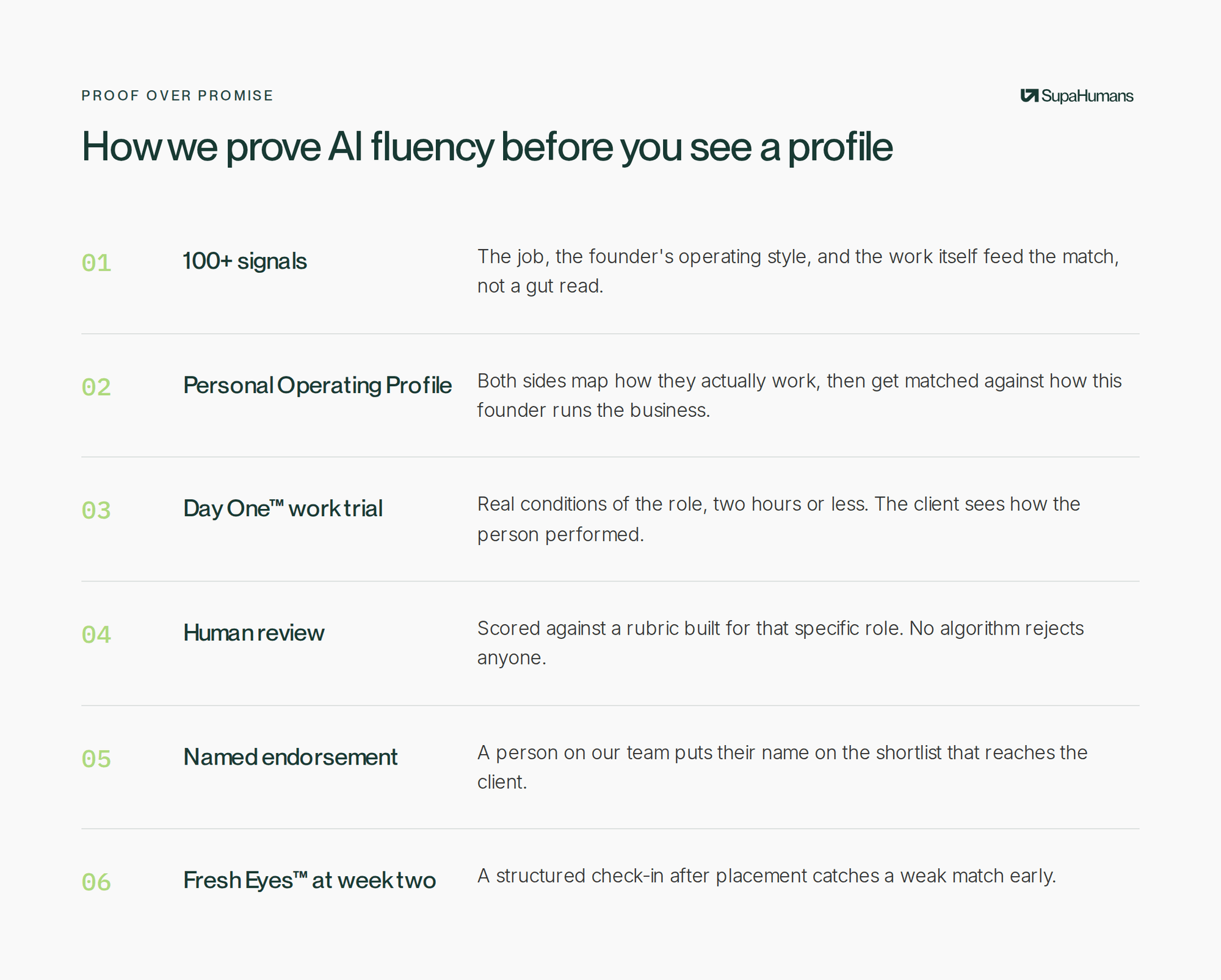
Every match starts with more than a hundred data signals spanning the role, the founder's operating style and the work itself. Both sides complete a Personal Operating Profile, our term for how someone actually works, and we match that against how this founder runs the business at this stage, not only the skills on a resume. Operators are also screened against a named set of thirteen behavioral traits, because a great operator in the wrong operating environment still fails.
Then comes Day One™, a structured work trial in the real conditions of the role, two hours or less. A human reviewer, not an algorithm, scores it against a rubric built for that specific seat, and a named person on our team writes the endorsement that reaches you. You see how someone actually performed before you decide on the person, not a resume and a gut call. We never keep, use, or ship the work itself, only the read on how they performed.
This asks more of us and of the candidate before anyone reaches a shortlist. The extra time upfront is why the match holds later.
Once the diagnostic maps the seat, matches can move in as little as 72 hours. Senior, technical or multi-hat roles take longer, and we scope the actual timeline before we promise one.
If a match still turns out wrong despite all of that, we replace the operator at no additional cost. Fresh Eyes™, a structured two-week check-in after placement, is what usually catches a weak match early enough that the guarantee rarely gets used.
You are not paying us to look. You are paying for a match that is already proven before you commit to it.
Laith Masarweh
What this looks like in real work
Investor updates. AI drafts the monthly numbers summary from raw data. The operator catches a metric that does not match the source sheet and holds send until it is confirmed.
Inbox triage. AI flags and drafts replies to routine requests. The operator escalates anything from a legal, press or upset-client sender instead of letting it auto-send.
Research briefs. AI pulls a first-pass competitive scan. The operator verifies each claim against a primary source before it reaches the founder's deck.
SOP documentation. AI turns a recorded walkthrough into a draft process doc. The operator edits it against how the task is actually done, not how AI assumed it works.
How to screen for AI fluency yourself
- Ask for a specific example of a task they sped up with AI, and what they changed before sending it.
- Give a short, real task, not a generic prompt test, and watch which tool they reach for and why.
- Ask what they would refuse to run through AI. The answer says more about judgment than any tool demo.
- Check how they document a process, not just how they complete one.
- Confirm what happens after they are hired. Is there coaching, or does their AI skill level freeze on day one?
Run those alongside the red flags that predict a bad remote hire and you will catch most of what an interview misses on its own.
How we built this guide
This guide draws on our own hiring data from the Day One™ work trial process, cross-checked against outside research on AI adoption and skills gaps, including 2026 workforce research from Microsoft, LinkedIn and ICIMS. The outside data is theirs. The process details are ours, verified against how we actually run a match. Pricing is not part of this piece; it is scoped per business at the Team Architecture Diagnostic™ stage, not published as a flat rate.
The bottom line
The gap between founders who feel faster with AI and founders drowning in AI-generated cleanup work almost always comes down to one hire's judgment, not the tools themselves. Testing for that judgment before day one, instead of hoping for it after, is the difference.
See the work before you decide on the person.
Laith Masarweh
Proof over Promise starts with a twenty-minute look at how your business actually runs. The Team Architecture Diagnostic™ maps it and hands back the seat that should come off your plate first. Twenty minutes, no contract. If it turns out you already know the seat cold, we will tell you so and skip straight to the work.
Proof over Promise.
The Assistantly x SupaHumans Team ⚡️
Common questions
This is how we hire, and it's the standard we hold our own team to. The long version lives in our manifesto. If you're hiring, start here. If you're talent, start here.